Packed Lunches for School and Work: Plan, Pack, Keep Cold
A note before you start: if a child has a food allergy, or if the nursery, school or workplace has a policy on certain foods (for example nuts), the lunchbox needs to follow the personal advice and the rules of that place first — not a general list.
Half past six in the morning, everyone is still in pyjamas, and someone has to decide what goes into the box. Then it sits for hours in a bag, on the bus or in the car, sometimes in the heat of an Israeli midday. A good lunchbox has to pass two tests: it should hold food that actually gets eaten and keeps you going until the evening, and that food should still be safe when the box is opened. In this article we go through the guidance of the U.S. Department of Agriculture's Food Safety and Inspection Service (USDA FSIS) on packing lunches from home, and the ideas of the UK's National Health Service (NHS) for a healthier lunchbox.
Why cold matters so much
According to USDA FSIS, harmful bacteria multiply rapidly in the "Danger Zone" — between 4.4°C and 60°C (40–140°F). So perishable food carried in a bag without a cold source will not stay safe for long. FSIS's basic rule: food should not be left at room temperature for more than 2 hours — and only 1 hour if the temperature is above 32°C (90°F). In an Israeli summer, in a bag standing in the sun or a parked car, that happens quickly.
FSIS also reminds us that prepackaged combos of luncheon meat, cheese and cut fruit contain perishable foods that must be kept refrigerated, even if they are cured or contain preservatives. We covered the "Danger Zone" and safe internal temperatures in our Food Thermometer Guide.
Building a healthier lunchbox
On its lunchbox page, the NHS suggests a few simple principles:
- A filling base. Base the main item on bread, rice, pasta or potatoes, and choose wholegrain where you can. If your child does not like wholegrain, make a sandwich from one slice of white bread and one slice of brown.
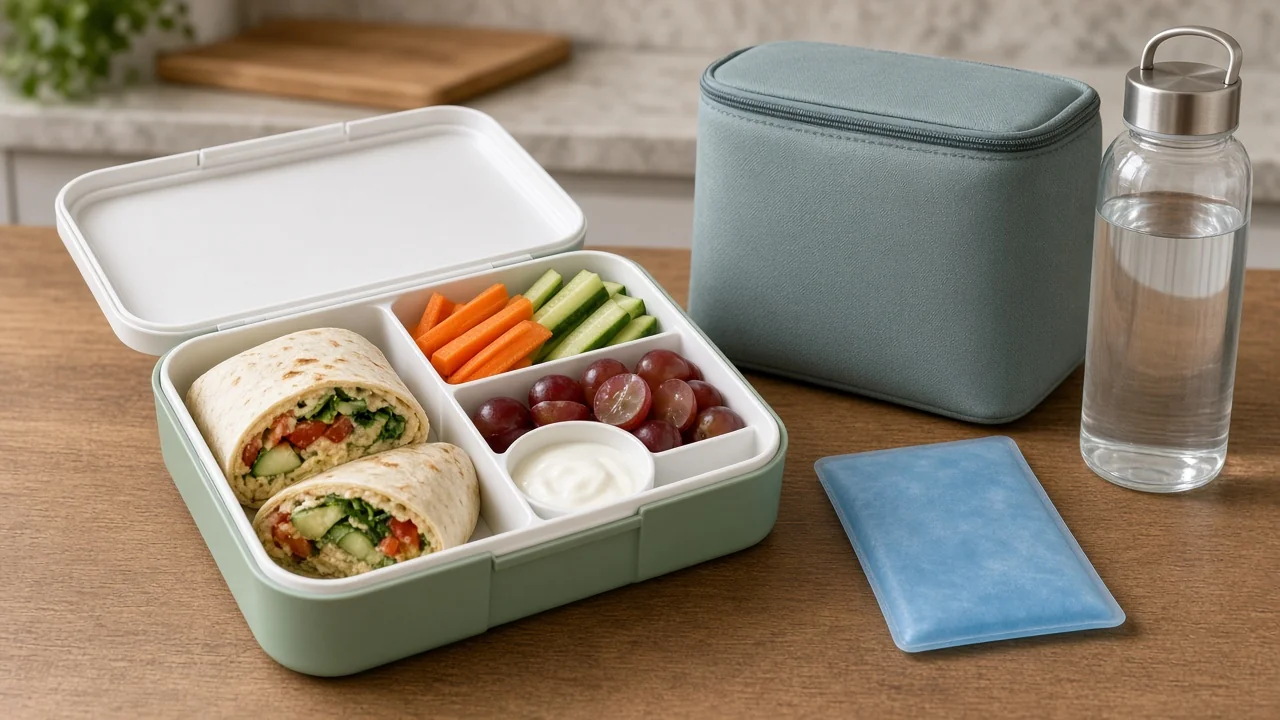
- Always add veg. Cherry tomatoes, or sticks of carrot, cucumber, celery and peppers; a small pot of hummus or another dip may help children eat their vegetables. Salad inside the sandwich or wrap counts too.
- Bite-sized fruit. Chopped apple, peeled satsuma segments, strawberries, blueberries, halved grapes or melon slices. A squeeze of lemon juice stops apple going brown.
- Lower-fat fillings. Chicken or turkey, tuna or salmon, reduced-fat cream cheese or reduced-fat hard cheese — and try to avoid mayonnaise in sandwiches. The NHS notes that cheese can be high in fat and salt, so it suggests choosing a stronger-tasting cheese and using less of it.
- Fewer crisps. If your child really likes crisps, include them less often and swap them for homemade plain popcorn or plain rice cakes.
- Dried fruit — at mealtimes. Raisins or dried apricots are often cheaper than processed fruit bars and can be healthier, but the NHS advises keeping dried fruit to mealtimes, as it can be bad for teeth.
- A different sweet. Instead of cakes, chocolate, cereal bars and biscuits — fruit bread or fruit (fresh, dried or tinned in juice, not syrup). A small pot of tinned fruit in juice keeps in the cupboard and suits a lunchbox well.
- Yoghurt — low-fat and lower-sugar, with your own fruit added.
We wrote about snack ideas, dried fruit and nuts in Nutritious Snacks at Home, and about vegetables and fruit in Vegetables and Fruits Every Day.
| Part of the box | Ideas (NHS; in brackets — our own home ideas) |
|---|---|
| Base | Wholegrain sandwich, wrap, pitta, bagel, pasta or rice salad (savoury pie, rice with meatballs) |
| Protein | Chicken or turkey, tuna, salmon, cheese, hummus (hard-boiled egg, beans) |
| Veg | Cherry tomatoes, carrot, cucumber, celery, pepper, salad in the sandwich |
| Fruit | Chopped apple with lemon, satsuma, strawberries, halved grapes, melon |
| Extra | Lower-sugar yoghurt, homemade popcorn, rice cakes |
| Drink | (A bottle of water — it can be frozen, see below) |
Planning for the week: fewer decisions in the morning
- Variety in the freezer. The NHS suggests keeping a few kinds of bread in the freezer — bagels, pittas, wraps, wholemeal and multigrain — so there is always some variety. We covered freezing in Freezing Food, and baking bread at home in Homemade Bread for Beginners.
- Cook ahead, pack in the morning. According to FSIS, it is fine to prepare the food the night before, but pack the lunch bag right before leaving home. Prepare cooked food — chicken, turkey, pasta or vegetable salads — ahead of time so it chills thoroughly in the fridge (4.4°C or below), and divide large amounts into shallow containers so they cool quickly. We wrote about cooking for several days in Weekly Meal Prep.
- Last night's leftovers. They can make a great lunch the next day, as long as they were kept in the fridge — see Leftovers in the fridge.
- Get the kids involved. The NHS recommends letting children choose and prepare part of their lunchbox, because they are more likely to eat it. Wraps and pots of fillings they assemble themselves, or dips, are a nice change from a sandwich every day. We covered planning a menu and shopping list for the whole week in A weekly family menu with a shopping list.
Packing safely
According to FSIS:
- Clean hands and surfaces. Wash your hands with soap and warm water for 20 seconds before you start, and wash boards, dishes, utensils and counters with hot, soapy water between food items.
- No cross-contamination. Cut bread, lettuce and tomatoes on a clean board — and if the board was used for raw meat or poultry, wash it first. Consider one board for fresh produce and a separate one for meat and poultry. More in Cross-contamination in the kitchen.
- Only what will be eaten. Pack just the amount of perishable food that will be eaten at lunchtime, so there are no leftovers to store. After lunch, throw away any leftover food, used packaging and paper bags, and do not reuse them, because they could contaminate other food.
- A frozen sandwich. Freezing sandwiches helps them stay cold. But for best quality, do not freeze sandwiches containing mayonnaise, lettuce or tomatoes — add those later.
Keeping the box cold
- An insulated bag and two cold sources. According to FSIS, insulated, soft-sided lunch bags are best for keeping food cold, but whatever bag or box you use, pack at least two cold sources with perishable food: two frozen gel packs (each no smaller than 5 by 3 inches, about 13 by 8 cm — our conversion), or one gel pack with a frozen juice box or a frozen bottle of water. Freeze the gel packs overnight and place them on top of and underneath the perishable food.
- A fridge on site. If there is a fridge at work or school, put perishable items in it as soon as you arrive. If you put the insulated bag itself in the fridge, leave it open so the cold air can reach the food.
What is fine without a cold source. According to FSIS, these items do not need refrigeration: whole fruits and vegetables, hard cheese, canned meat and fish, crisps, breads, crackers, peanut butter, jam, mustard and pickles. (Note: once a tin is opened or fruit is cut, the rules change.)
A hot lunch in a box
- A preheated flask. According to FSIS, to keep soup, chilli or stew hot, use an insulated container: fill it with boiling water, let it stand for a few minutes, empty it and put in the piping hot food. Keep it closed until lunchtime so the food stays at 60°C (140°F) or above.
- Microwaving at work. According to FSIS, cover the food to hold in moisture and help it heat evenly, and reheat leftovers to at least 74°C (165°F), checking with a food thermometer. Frozen ready meals — according to the package instructions. We covered suitable containers, wattage and stirring halfway in Microwave Cooking.
Where KitchenAppes fits in
Keep the savoury pie, pasta salad and meatballs that work well in a lunchbox in one place in the KitchenAppes recipe book, with your own notes such as "freezes well" or "no mayo". And if the fridge holds half a chicken, some rice and a few vegetables in the evening, Smart Chef can suggest a recipe from the ingredients you already have — maybe for tomorrow's lunchbox.
In short
- Danger Zone: 4.4°C–60°C. No more than 2 hours at room temperature, and 1 hour above 32°C (FSIS).
- Build the box from a filling base (wholegrain if possible), leaner protein, veg, bite-sized fruit and few snacks (NHS).
- Prepare in the evening, pack right before leaving; an insulated bag and at least two cold sources, on top and underneath (FSIS).
- Hot lunch in a preheated flask, above 60°C; microwave reheating to 74°C, checked with a thermometer (FSIS).
- Throw away anything not eaten, including used packaging (FSIS).
Sources
- USDA FSIS. Keeping "Bag" Lunches Safe (Last Updated: Jul 25, 2025). Checked 26 November 2026
- NHS Healthier Families. Healthier lunchbox recipes. Checked 26 November 2026
KitchenAppes
Download the app