Vegetables and Fruits Every Day: How Much, Colors, Washing
We all know we "should eat more vegetables and fruits." The real question is what that means in practice: how much is "more," whether the tomato and cucumber in a chopped salad count, whether frozen vegetables are just as good, and what to make of a glass of orange juice at breakfast. In this article we bring together what the World Health Organization (WHO), the nutrition website of the Harvard T.H. Chan School of Public Health, and the U.S. Food and Drug Administration (FDA) say, along with simple ideas for working vegetables and fruits into every meal, from the supermarket to the plate.
This is general information, not medical or personal nutrition advice. Needs vary with age, health conditions, medications and your overall diet, and some medical conditions call for specific adjustments to which vegetables and fruits you eat. For personal advice, talk to a registered dietitian.
Why vegetables and fruits matter so much
According to Harvard, a diet rich in vegetables and fruits can lower blood pressure, reduce the risk of heart disease and stroke, lower the risk of eye and digestive problems, and have a positive effect on blood sugar, which can help keep appetite in check. They stress two simple principles: no single fruit or vegetable provides all the nutrients your body needs, and variety is as important as quantity.
It's also worth knowing what the research does *not* show. Harvard notes that large cohort studies have not consistently shown that a diet rich in fruits and vegetables prevents cancer in general; the more likely possibility is that some types of fruits and vegetables may protect against certain cancers. In other words, vegetables and fruits are an important part of a healthy diet, not a miracle cure.
Roughly how much: 400 grams a day
The WHO recommends that everyone older than 10 aim for at least 400 grams of fruits and vegetables per day. Children need less: at least 250 grams a day at ages 2–5, and at least 350 grams at ages 6–9.
Harvard also cites observational research: when researchers combined the Harvard studies with several other long-term studies in the U.S. and Europe, people who ate more than 5 servings of fruits and vegetables a day had roughly a 20% lower risk of coronary heart disease and stroke than people who ate fewer than 3 servings a day. Keep in mind that this is an association found in population studies, not a personal promise.
Eat the rainbow: five groups for every day
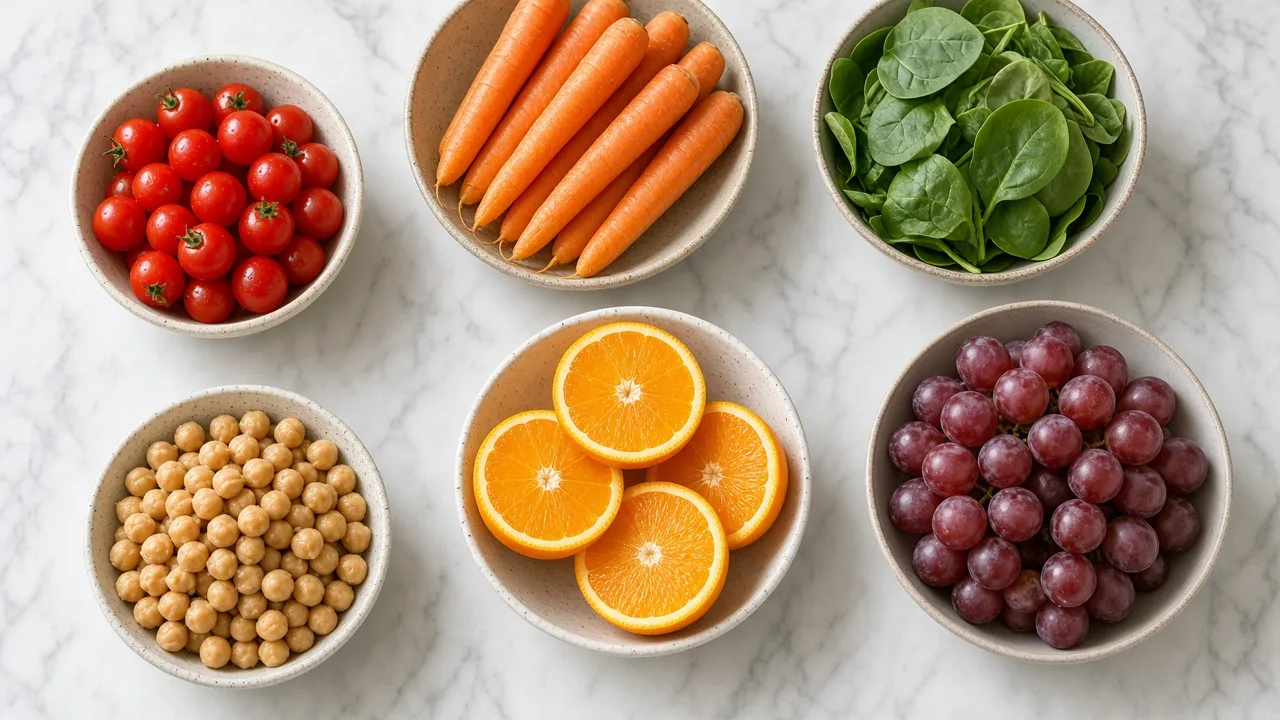
According to Harvard, there are at least nine different families of fruits and vegetables, each with potentially hundreds of plant compounds that are beneficial to health. That's why they recommend eating a variety of types and colors. On most days, they suggest trying to get at least one serving from each of these groups (the examples are ours):
- Dark green leafy vegetables: spinach, Swiss chard, lettuce and other leafy greens.
- Yellow or orange fruits and vegetables: for example carrots, pumpkin and sweet potatoes.
- Red fruits and vegetables: for example tomatoes, red peppers and pomegranates.
- Legumes (beans) and peas: lentils, chickpeas and beans. Plenty of ideas in our guide to legumes in the home kitchen.
- Citrus fruits: oranges, lemons, clementines and grapefruit.
Harvard notes that in their studies, green leafy vegetables were most strongly associated with a lower risk of cardiovascular disease, and that cruciferous vegetables (broccoli, cauliflower, cabbage, Brussels sprouts and kale) and citrus fruits also made important contributions.
What about potatoes? One of Harvard's tips is to "skip the potatoes" and choose other vegetables, which are packed with different nutrients and more slowly digested carbohydrates. In their research on weight, starchier vegetables like potatoes, corn and peas were linked with weight gain, while berries, apples, pears, soy and cauliflower were associated with weight loss. They add a caveat: eating more produce won't necessarily help with weight loss unless it *replaces* another food, such as the refined carbohydrates in white bread and crackers.
Fresh, frozen or canned? And what about juice?
- Frozen and canned are fine. According to the WHO, fresh fruit and vegetables are great choices, but frozen and canned are also good, provided they don't have added sugars or excess sodium. A bag of frozen green beans or broccoli is an easy way to add a vegetable to dinner on a busy day.
- Juice in moderation. The WHO says fruit juice can be consumed, but most varieties, even those without added sugars, contain significant amounts of "free sugars," which should be limited. Harvard adds that in their studies, eating whole fruits, especially blueberries, grapes and apples, was associated with a lower risk of type 2 diabetes, while greater consumption of fruit juice was associated with a higher risk. So a whole orange beats a glass of juice. More on this in our guide to free sugars.
- Dietary fiber. According to Harvard, the fiber in vegetables and fruits absorbs water and expands as it passes through the digestive system, and can help keep bowel movements regular. More in our article on dietary fiber.
Buying, storing and washing produce safely
Fresh produce can come into contact with bacteria from the soil or water where it grows, and can also become contaminated after harvest, during storage or preparation. The FDA recommends a few simple habits:
When buying:
- Choose produce that is not bruised or damaged.
- Buy pre-cut or packaged produce, such as half a watermelon or a bag of salad greens, only if it is refrigerated or surrounded by ice.
- Bag fruits and vegetables separately from raw meat, poultry and seafood on the way home.
When storing:
- Keep perishable produce (such as strawberries, lettuce, herbs and mushrooms) in a clean refrigerator at 4°C (40°F) or below. A fridge thermometer helps you check.
- Refrigerate all produce that was bought pre-cut or packaged.
When preparing:
- Wash your hands with soap and warm water for at least 20 seconds before and after preparing produce.
- Cut away any damaged or bruised areas, and throw away produce that looks rotten.
- Wash all produce thoroughly under running water, including produce grown at home or bought at a farmers' market. The FDA does not recommend washing produce with soap, detergent or commercial produce washes: produce is porous and can absorb soap and detergent, and the safety of commercial wash residues is unknown and their effectiveness hasn't been tested.
- Wash produce even if you plan to peel it, so dirt and bacteria aren't transferred from the surface when you peel or cut it.
- Scrub firm produce, such as melons and cucumbers, with a clean produce brush, then dry it with a clean cloth or paper towel.
- Produce labeled "pre-washed" or "ready-to-eat" can be used without further washing.
- If possible, use one cutting board for fresh produce and a separate one for raw meat. More in our guide to cross-contamination in the kitchen.
The FDA also notes that people who are more vulnerable to foodborne illness (children, older adults, pregnant women and people with weakened immune systems) should avoid eating raw or lightly cooked sprouts of any kind.
How to add more vegetables and fruits to your meals
Harvard offers a few tips, and we've added ideas from an everyday Israeli kitchen:
- Keep fruit where you can see it. A bowl of washed fruit on the counter, or a glass container of chopped colorful fruit in the fridge, instead of a sweet snack.
- Try something new. On every shopping trip, pick one vegetable or fruit you haven't bought in a while. According to Harvard, variety and color are key. Supermarket deals can help; see how to build a menu around supermarket deals.
- Make it a meal. Salads, soups and stir-fries are, according to Harvard, easy ways to eat more vegetables. For example: an orange vegetable soup with pumpkin and carrots, shakshuka loaded with peppers and spinach, or a vegetable stir-fry with tofu.
- Add some to every plate. A handful of greens in a sandwich, cucumber and tomato with breakfast, roasted cauliflower or broccoli next to the chicken.
- Don't throw out what's left. Half a cabbage, two carrots and a few herbs are the start of a meal. More tips in our article on reducing food waste at home.
Where KitchenAppes comes in
In KitchenAppes you can find soups, salads, legume stews and roasted vegetable dishes, and keep your favorite recipes in one place. And if half a head of broccoli, two carrots and a single pepper are waiting in the fridge, Smart Chef can suggest a recipe from the ingredients you already have at home.
Sources
- World Health Organization (WHO): Healthy diet, Fact sheet
- Harvard T.H. Chan School of Public Health, The Nutrition Source: Vegetables and Fruits
- U.S. Food and Drug Administration (FDA): Selecting and Serving Produce Safely
KitchenAppes
Download the app