Nutritious Snacks at Home: Ideas, Label Reading and Portions
This is general information, not personal medical or nutrition advice. If you have diabetes, a food allergy, an eating disorder or kidney disease, if a doctor or dietitian has given you dietary instructions, if you are pregnant or breastfeeding, or if you are feeding babies and toddlers, follow the personal advice you have been given. In a severe allergic reaction — difficulty breathing, swelling of the lips or throat, dizziness or fainting — call your local emergency number straight away (in Israel, Magen David Adom on 101).
Mid-afternoon, when the kids get home from school, or in the evening in front of a screen — a hand reaches for the cupboard. A snack is not a "sin", and it can be a normal part of a balanced day of eating. The real questions are what is within reach and how much of it. In this article we look at what official bodies write about snacks: what is worth keeping on hand, which simple swaps work, how to read a label and the Israeli Ministry of Health's red symbol, and what to know about dried fruit, nuts and young children.
What makes a snack "nutritious"
The World Health Organization (WHO) describes a healthy diet as one based on a variety of minimally processed and unprocessed foods that are low in unhealthy fats, free sugars and sodium. On the same page, WHO explicitly mentions packaged snacks: it recommends limiting salty snacks to cut down on salt, and limiting baked and fried foods and pre-packaged snacks (such as cookies, wafers and doughnuts) that may contain industrially produced trans fat.
On the other side, WHO recommends that everyone over the age of 10 eat at least 400 grams of fruit and vegetables a day and at least 25 grams of naturally occurring dietary fibre from food. A snack is a good opportunity to cover part of that. We wrote about fibre in detail in Dietary fibre: how much a day and easy ways to add more, and about fruit and vegetables in Vegetables and Fruits Every Day.
A practical rule of thumb: a nutritious snack is built on whole foods — a vegetable, a fruit, a plain dairy product, an egg, pulses, nuts or a whole grain — rather than on a product that is mostly sugar, salt and fat by weight.
Ideas from the fridge and the pantry
On its snacks page for children, the UK's National Health Service (NHS) offers a list of simple homemade ideas that work just as well for adults:
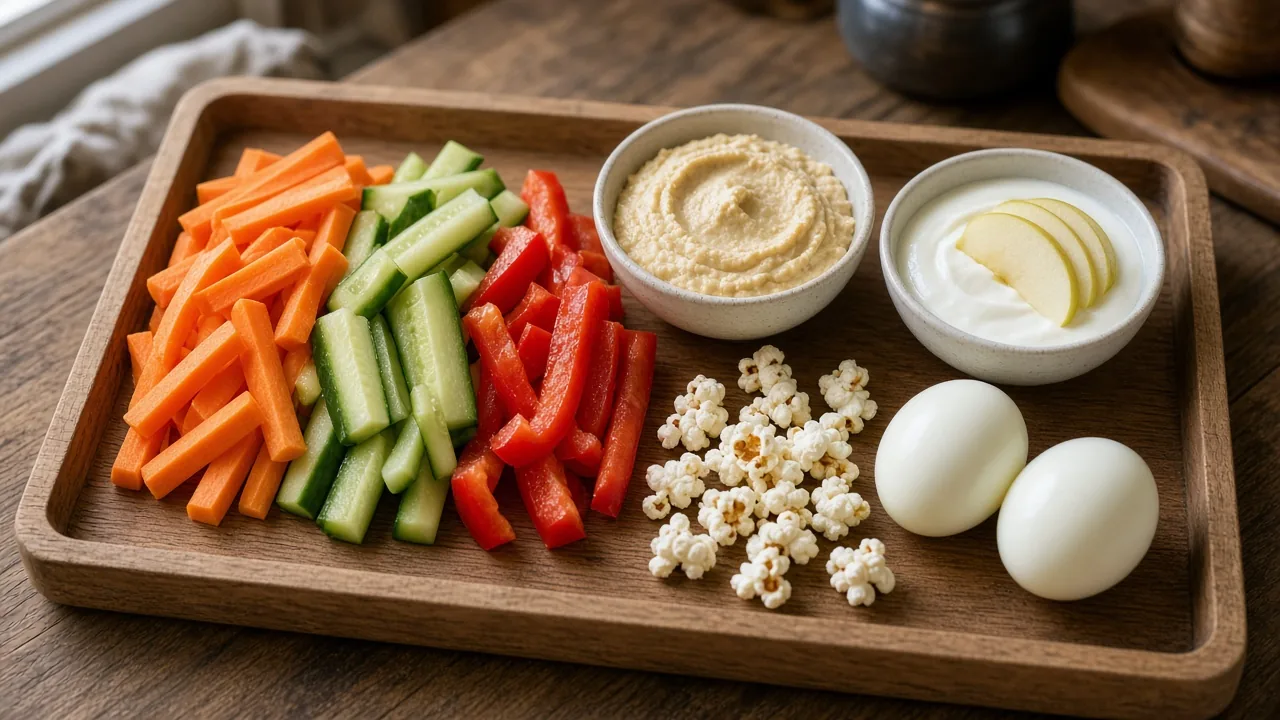
- Chopped vegetables with hummus — carrot, cucumber, pepper and celery sticks, or sugar snap peas, with hummus.
- Plain yoghurt with fruit — unsweetened natural yoghurt with mandarin segments or sliced fruit.
- A hard-boiled egg, on its own or with mashed avocado.
- Homemade popcorn.
- Rice cakes or crackers with lower-fat cheese and cucumber slices.
- Toasted pitta with tuna and a yoghurt dip.
- Cherry tomatoes, fruit kebabs and watermelon slices.
And a few additions from the Israeli kitchen — home ideas, not recommendations from a source: a small bowl of chopped vegetable salad, soft white cheese with fresh herbs on a slice of wholegrain bread, cooked edamame, or a small handful of nuts that have not been roasted in salt.
Simple swaps
The NHS offers a table of swaps for snacks and puddings. The idea is not to give up the snack, but to replace it with something with less sugar, salt and fat.
| Instead of | Try |
|---|---|
| Biscuits, chocolate, cake bars | Fresh fruit, or tinned fruit in juice (not syrup) |
| Crisps | Plain popcorn or rice cakes |
| Salted peanuts | Unsalted mixed nuts |
| Muffins and doughnuts | Bread or toast with lower-fat spread, crackers with lower-fat cheese |
| Higher-sugar yoghurts | Lower-sugar yoghurt, or plain yoghurt with fruit |
| — | Chopped vegetables with hummus |
The NHS adds that even one or two everyday swaps can make a difference.
How to read a snack label
When you buy a packaged snack, the label is the fastest tool you have.
Israel's red symbol. According to the Ministry of Health (the national "Efsharibari" programme), since January 2021 a solid food product must carry a red symbol on the front of the pack if 100 grams contain more than 400 mg of sodium, more than 10 g of sugars or more than 4 g of saturated fat. For drinks, per 100 ml, the thresholds are 300 mg of sodium, 5 g of sugars and 3 g of saturated fat. The Ministry also stresses that the absence of a red symbol does not by itself make a product "healthy" or "recommended".
The per-100 g column. To compare two snacks, compare the values per 100 grams rather than "per serving", because the manufacturer's idea of a portion may be different from yours — the NHS says this explicitly. Under UK guidelines, more than 22.5 g of total sugars per 100 g counts as "high" and 5 g or less as "low"; more than 1.5 g of salt per 100 g is "high" and 0.3 g or less is "low". The UK thresholds differ from Israel's, so they are shown here only as an illustration.
The ingredients list. According to the NHS, ingredients are listed in descending order of weight. If sugar, oil or syrup is among the first few, that is a clear hint. We explained how to read the nutrition values of a home recipe in Nutrition facts in a recipe.
Dried fruit, nuts and juice
- Dried fruit. According to the NHS, a portion of dried fruit is around 30 g — about a heaped tablespoon of raisins, 2 figs or 3 prunes — and it counts as a portion of fruit. But dried fruit is high in sugar and sticks to teeth, so the NHS recommends eating it as part of a meal, for example as dessert, rather than as a between-meal snack.
- Nuts and seeds. The NHS calls them a healthier snack, but high in energy, so it is worth keeping an eye on the amount. Unsalted nuts are a better choice than salted ones; we covered the salt hidden in food in Salt in home cooking.
- Juice and smoothies. According to the NHS, your combined total of fruit juice, vegetable juice and smoothies should not be more than 150 ml a day (a small glass), and it is best drunk with a meal. WHO classifies the sugars in fruit juice as "free sugars". The NHS also warns that a sugary drink alongside a snack doubles up the sugar in one go. Water is the better choice — see Water and Everyday Drinking, and for WHO's sugar limit, Free sugars: WHO daily limit and how to cut back at home.
Snacks for children
The NHS writes that fruit and vegetable snacks are always the best choice for children, and that if they are having packaged snacks, to aim for 2 a day max.
And two important safety rules:
- No whole nuts for children under 5. This is explicit NHS advice. Grapes are worth halving — "halved grapes" are what the NHS lists in its snack ideas.
- Allergies. If there is a child with an allergy at home or at nursery, the snack has to follow that child's personal advice, not a general list.
Some practical tips from the same NHS page: get the children involved in the preparation (chopping, arranging), keep a fruit bowl where it can be seen, take a banana, an apple or chopped vegetables with you when you go out, and "the simplest trick in the book": if you do not have sweets in the house, you cannot eat them.
Prep ahead: a fridge that works for you
The NHS suggests filling the fridge with fruit and vegetables that are already chopped and ready to eat — apple, carrot, cucumber, celery, peppers, peeled satsuma segments, strawberries, halved grapes or melon slices — so they are the first thing you see when you open the door. A few more kitchen ideas:
- A clear box at eye level with vegetable sticks, and a small tub of hummus next to it.
- Hard-boiled eggs for a few days — kept in the fridge and eaten within a week of cooking (according to the FDA; we covered this in Eggs in the Kitchen).
- Small portions in advance: a handful of nuts in a small container, not the whole bag in front of the TV.
- Homemade popcorn in a lidded pot with a little oil, and a little salt or spice to taste.
Where KitchenAppes fits in
Keep the dips, homemade snacks and small salads you come back to in one place in the KitchenAppes recipe book. And if your fridge has carrots, yoghurt and half a tub of hummus but no clear plan, Smart Chef can suggest a recipe from what you already have. The app does not count the calories of the snacks you eat, does not track what you eat during the day, does not build a personal diet plan and does not replace medical or nutrition advice.
In short
- A nutritious snack is built on whole foods: vegetables, fruit, plain dairy, eggs, pulses, nuts and whole grains.
- Simple swaps (NHS): fruit instead of a biscuit, plain popcorn instead of crisps, unsalted nuts instead of salted peanuts.
- On the label: a red symbol means a lot of sodium, sugar or saturated fat; compare per 100 g and check what comes first in the ingredients list.
- Dried fruit — with a meal; juice — up to 150 ml a day with a meal; nuts — in small amounts.
- Children: packaged snacks — no more than 2 a day (NHS); no whole nuts under the age of 5.
Sources
- WHO. Healthy diet (Fact sheet, updated 26 January 2026). Checked 25 November 2026
- NHS Healthier Families. Healthier snacks for kids. Checked 25 November 2026
- NHS Healthier Families. Healthier food swaps. Checked 25 November 2026
- NHS. Food labels (Page last reviewed: 30 June 2026). Checked 25 November 2026
- NHS. 5 A Day portion sizes. Checked 25 November 2026
- Israel Ministry of Health, Efsharibari. Regulations on labelling unhealthy food products (in Hebrew). Checked 25 November 2026
- Magen David Adom. Ask for Help — 101. Checked 25 November 2026
KitchenAppes
Download the app