Water and Everyday Drinking: How Much, and What Counts
This is general information, not personal medical or nutrition advice. If your doctor has told you to limit fluids (for example because of a heart or kidney condition), if you take diuretics, if you are pregnant or breastfeeding, or for babies, follow your doctor's personal advice. If there are signs of severe dehydration — confusion, unusual drowsiness, fast breathing, or cold, pale skin — call your local emergency number straight away (in Israel, Magen David Adom on 101).
Water may be the simplest "ingredient" in the kitchen, yet it comes wrapped in rules of thumb: "eight glasses a day", "coffee dehydrates you", "if you're thirsty it's already too late". In this article we look at what official bodies actually write: how much water is considered an adequate intake, why the numbers differ between Europe and the United States, what counts as a drink, which signs suggest dehydration, and how to turn the kitchen into a place where drinking is easy — without unnecessary sugar. We covered the sugar hidden in drinks in detail in Free sugars: WHO daily limit and how to cut back at home.
How much water: what the official bodies say
The two main bodies that have set reference values for water are the European Food Safety Authority (EFSA) and the U.S. National Academies of Sciences, Engineering, and Medicine (NASEM, then still the Institute of Medicine). Neither set an exact "requirement". Both set an Adequate Intake, because water needs vary a great deal between people and conditions. And both talk about total water — drinking water, beverages of every kind, and the water contained in food.
| Group | EFSA (2010) — total water per day | NASEM (2004) — total water per day |
|---|---|---|
| Adult women | 2.0 litres | about 2.7 litres |
| Adult men | 2.5 litres | about 3.7 litres |
| Pregnancy | same as non-pregnant women + 300 ml | — (not in the summary we checked) |
| Lactation | about 700 ml above non-lactating women | — (not in the summary we checked) |
According to EFSA, the values for children are 1.3 litres a day at ages 2–3, 1.6 litres at ages 4–8, 2.1 litres for boys and 1.9 litres for girls at ages 9–13; from age 14 the adult values apply. EFSA sets the same values for older adults as for younger adults, and notes that water needs per unit of energy rise with age because the kidneys become less able to concentrate urine.
The small print matters. According to EFSA, these values apply only at moderate environmental temperatures and moderate physical activity. In extreme heat and with physical exertion, water losses can reach about 8 litres a day, and both the water and the salts lost in sweat need replacing.
Why do the numbers differ?
Both bodies based their values mainly on intakes actually observed in populations that appeared well hydrated, using somewhat different methods. So the numbers are not a target to tick off, but an order of magnitude. In the news release published with its report, NASEM said explicitly that it does not offer a rule of thumb for how many glasses to drink a day, and that most healthy people meet their needs through normal drinking at meals and in social situations and by letting thirst guide them. People who are very active or live in hot climates may need more.
The UK National Health Service (NHS) offers a more practical way to look at it: aim to drink enough during the day that your pee is a clear, pale yellow. The general UK guidance is 6 to 8 cups or glasses of fluid a day, and the NHS stresses that this is just a guide — you may need more if you are pregnant or breastfeeding, in a hot environment, physically active for long periods, or ill or recovering from illness.
What counts: not just tap water
According to NASEM, on average about 80% of total water comes from water and other beverages, and about 20% from food. So a bowl of soup, a cucumber, an orange or a slice of watermelon is a real part of the total.
What counts, according to the sources:
- Water — the simple, cheap choice, with no calories.
- Lower-fat milk and lower-sugar drinks, including tea and coffee — according to the NHS, all of these count towards your daily intake.
- Coffee and tea — NASEM concluded that the diuretic effect of caffeine appears to be transient, and that there is no convincing evidence that it leads to a cumulative water deficit in the body; so caffeinated drinks contribute to daily hydration just as non-caffeinated ones do. That said, according to the U.S. Centers for Disease Control and Prevention (CDC), moderate intake for most adults is up to 400 mg of caffeine a day — about 2 to 3 cups of plain coffee — and according to the NHS, no more than 200 mg a day during pregnancy.
- Water-rich food — the CDC notes that many fruits and vegetables add to fluid intake. In the context of caring for an older person, the NHS mentions soup, jelly and fruits such as melon.
And what is not a good fix: according to the NHS, if you are dehydrated it is better to avoid caffeinated drinks and alcohol; alcohol is one of the factors that raise the risk of dehydration.
General signs of dehydration
Dehydration means the body loses more fluids than it takes in. According to the NHS, symptoms in adults and children include:
- feeling thirsty;
- a headache, and feeling dizzy or light-headed;
- dark yellow, strong-smelling pee, or peeing less often than usual;
- feeling tired;
- a dry mouth, lips and tongue;
- sunken eyes.
In babies, the NHS lists among other signs a sunken soft spot on the top of the head, few or no tears when crying, fewer wet nappies than usual, and drowsiness or irritability. Babies, children and older adults are at higher risk.
Dehydration happens more easily with vomiting or diarrhoea, long periods in the sun or heat, a high temperature, heavy sweating after exercise, after drinking alcohol, with diabetes, when taking medicines that make you pee more (diuretics), and in people who rely on others to get them drinks.
When to get help: according to the NHS, feeling unusually tired, dizziness on standing that does not go away, dark pee or peeing less than normal, and fast breathing or a fast heart rate are signs that call for an urgent appointment with a doctor. Confusion, being unusually sleepy or hard to wake, difficulty breathing, cold skin, or blue, grey, pale or blotchy skin, lips or tongue are signs of an emergency — call your local emergency number (in Israel, 101). With vomiting or diarrhoea, a pharmacist can recommend an oral rehydration solution.
Can you drink too much?
It is rare, but yes. According to EFSA, drinking more than the kidneys can excrete — a maximum of about 0.7 to 1.0 litres an hour in adults — can lead to dangerous water intoxication with low blood sodium. NASEM noted that such cases have occurred in some athletes during strenuous activity and in some people with certain psychiatric disorders, but that they are highly unusual, so no upper limit was set for water. The practical takeaway: drink throughout the day, rather than trying to "catch up" on litres all at once.
Sugary drinks versus water
According to the CDC, regular sodas, fruit drinks, sports and energy drinks, sweetened waters, and sweetened coffee and tea provide calories but little nutritional value. Energy drinks may also contain large amounts of caffeine and other stimulants. The CDC also writes that water has no calories, so replacing sugary drinks with plain water can help reduce calorie intake.
What about juice? The World Health Organization counts fruit juice as a "free sugar" (we explained this in our article on free sugars). The NHS recommends limiting fruit juice and smoothies to a maximum of one small glass (150 ml) a day, drunk with a meal. For children, according to the NHS, the best drinks are water and milk, and they should avoid sugary fizzy drinks, squash and juice drinks completely.
And "diet" drinks? According to the CDC, they usually contain high-intensity sweeteners, which may reduce calorie intake in the short term, but there are still many questions about their effectiveness over the long term. The NHS suggests them as a swap for sugary drinks. Water remains the basic choice.
Kitchen ideas: drinking more without sugar
A few simple ideas — some from the CDC and NHS recommendations, some everyday home habits:
- A jug of water on the table at every meal. The CDC recommends serving water with meals; when the jug is already there, it is easier to pour.
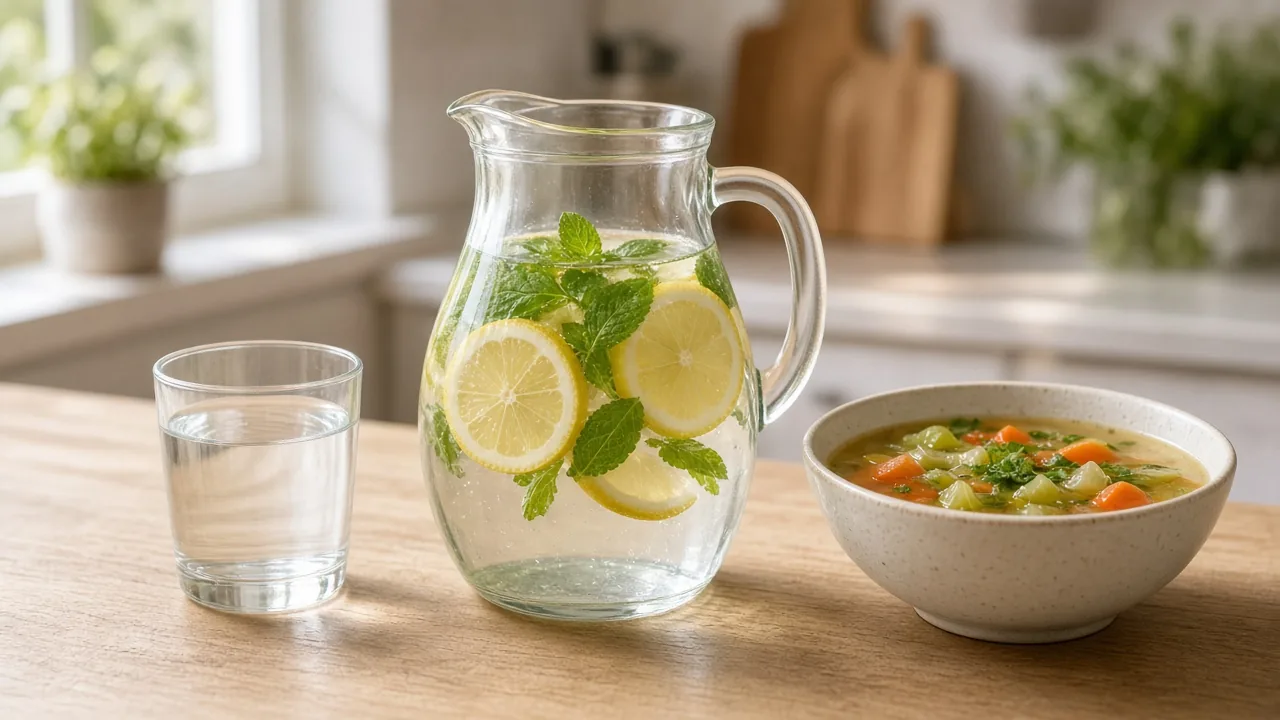
- Flavoured water without sugar. A slice of lemon or lime (both appear in the CDC and NHS tips), plus other home options: cucumber slices, mint or basil leaves, slices of ginger, a few frozen raspberries or strawberries. Fill a jug in the evening and keep it in the fridge.
- Sparkling water — the NHS suggests it for people who don't like the taste of plain water.
- A bottle that comes with you. The CDC suggests carrying a reusable bottle, and freezing water in a freezer-safe bottle so it stays cold through the day.
- Hot or iced herbal tea, unsweetened — mint, lemon verbena or chamomile, brewed and chilled in a jug.
- Soup as part of the meal. Vegetable, lentil or tomato soup adds fluid to a meal. Watch the salt: ready-made soups and powdered mixes are high in sodium, which we covered in Salt in home cooking.
- Vegetables and fruit at every meal — a cucumber and tomato salad, watermelon or melon in summer, an orange in winter. More ideas in Vegetables and Fruits Every Day.
- Drink before going out into the heat and after exercise, and when someone at home is ill, offer small sips often.
Where KitchenAppes fits in
Keep the soups, salads and flavoured-water jugs you come back to in one place in the KitchenAppes recipe book. And if your fridge has cucumbers, tomatoes and lentils but no clear plan, Smart Chef can suggest a recipe from what you already have. The app does not calculate water intake, does not track drinking, and does not replace medical or nutrition advice.
In short
- Official values refer to total water from drinks and food: according to EFSA about 2.0 litres for women and 2.5 litres for men, according to NASEM about 2.7 and 3.7 litres, under moderate conditions.
- About 20% of water comes from food; tea, coffee and milk count too.
- A practical sign: pale yellow pee. Heat, exercise and illness raise needs.
- Water is the basic choice; juice — one small glass with a meal; sugary drinks — not as a habit.
- Emergency signs of dehydration — call your local emergency number (in Israel, 101).
Sources
- EFSA Panel on Dietetic Products, Nutrition and Allergies (NDA). Scientific Opinion on Dietary Reference Values for water. EFSA Journal 2010;8(3):1459. Figures verified from EFSA's official Dietary Reference Values for nutrients — Summary report (2017, section 3.5 Water) and EFSA news release of 26 March 2010. The journal page itself did not open during checking (blocked/timed out). Checked 24 November 2026
- National Academies (Institute of Medicine). Report Sets Dietary Intake Levels for Water, Salt, and Potassium To Maintain Health and Reduce Chronic Disease Risk (February 11, 2004). Checked 24 November 2026
- NHS. Water, drinks and hydration (Page last reviewed: 17 May 2023; the next review date shown on the page, May 2026, has passed). Checked 24 November 2026
- NHS. Dehydration. Checked 24 November 2026
- CDC. About Water and Healthier Drinks (Mar. 5, 2026). Checked 24 November 2026
- Magen David Adom. Ask for Help — 101. Checked 24 November 2026
KitchenAppes
Download the app