Microwave Cooking: Safe Heating, Containers and Wattage
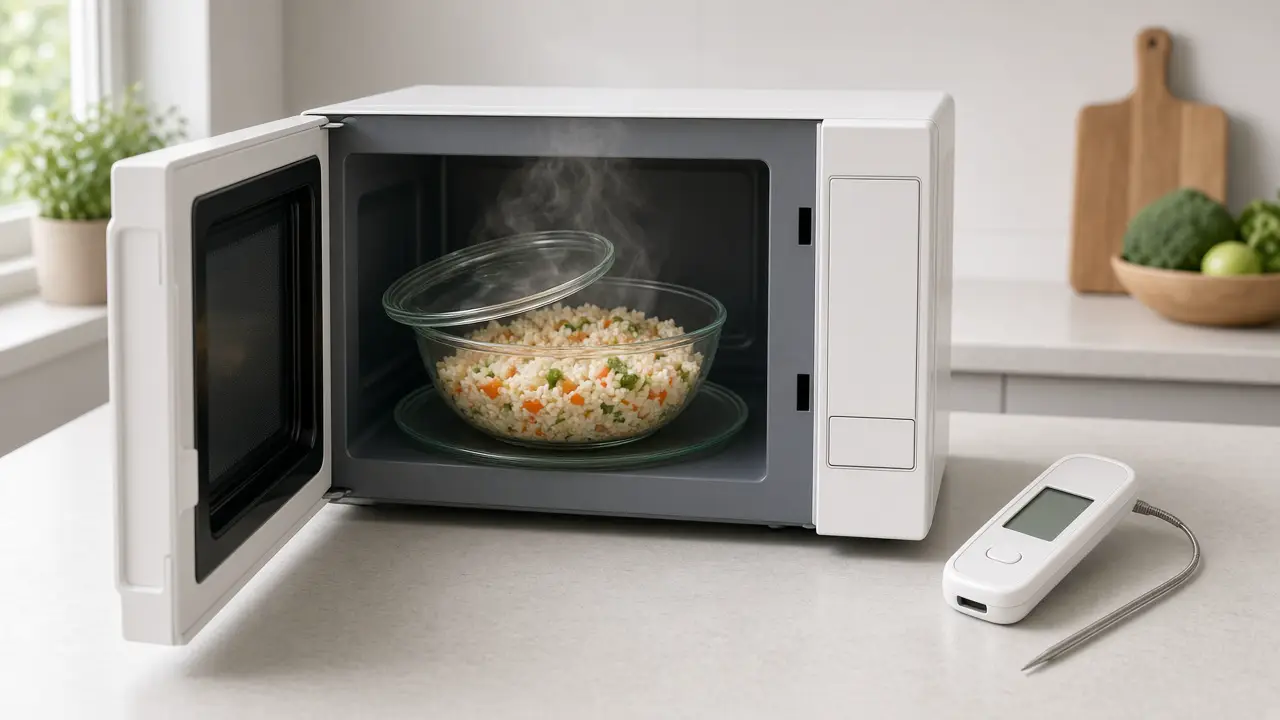
The microwave may be the most-used appliance in the kitchen. According to the U.S. Department of Agriculture's Food Safety and Inspection Service (USDA FSIS), over 90% of homes in America have at least one. But the same appliance that heats a meal in two minutes can also leave "cold spots" in the middle of a dish, melt the wrong container or splash boiling water. In this guide we cover how a microwave works, how to cook and reheat evenly and safely, which containers are safe and which are not, what to do with aluminum foil, and how to check your oven's wattage. The guide is based on USDA FSIS, the U.S. Food and Drug Administration (FDA) and University of Nebraska–Lincoln Extension.
How a microwave works — and what it does not do
According to USDA FSIS, a part called the magnetron converts ordinary electric power from the wall socket into very short radio waves, at a frequency of about 2,450 megahertz. At that frequency, water, fats and sugars in food absorb the energy, the molecules vibrate very fast — and that creates heat.
Three common myths, and what the sources say:
- "Microwaves cook from the inside out." No. According to FSIS, microwaves penetrate food to a depth of about 1 to 1½ inches (2.5–4 cm). In a thick piece, the center cooks by heat conducted from the outer layers. The FDA explains it the same way.
- "Microwaves make food radioactive." No. According to FSIS and the FDA, this is non-ionizing radiation, similar to radio and television waves, and it does not make food "radioactive" or "contaminated."
- "Microwaving destroys vitamins." According to the FDA, microwave cooking does not reduce the nutritional value of foods any more than conventional cooking, and foods may even keep more of their vitamins and minerals, because microwaving is fast and needs little water. See also Vitamin C in the Kitchen.
One more point from FSIS: the air inside a microwave stays at room temperature, so microwaved food does not normally brown or get crispy. If crispness is what you want, other appliances do it better — see which appliance to choose for dinner.
Power levels: what "50%" actually means
According to FSIS, on high power (100%) the magnetron runs at full capacity. At lower settings it cycles on and off: "50%" means the oven produces microwaves half the time and is off the other half.
- High power suits tender, moist foods: ground beef, poultry, vegetables and fruit.
- Reduced power is better for eggs, cheese and solid meat, which can toughen on high.
- Large cuts of meat — according to FSIS, not on full power but at 50% for longer, so heat reaches the center without overcooking the outside.
Even cooking and reheating: the USDA rules
According to FSIS, microwaves can cook unevenly and leave cold spots where harmful bacteria can survive. The rules:
- Arrange food evenly in a covered dish, and add a little liquid if needed. With large pieces of meat, debone where possible — bone can shield meat from thorough cooking.
- Cover, and leave a vent. Use a lid or microwave-safe plastic wrap, with enough space that the wrap does not touch the food, and loosen a corner. The moist heat helps destroy harmful bacteria and heats evenly.
- Stir or turn food midway — even if your microwave has a turntable.
- Start with the shortest time when instructions give a range, and add more if needed.
- Standing time. According to FSIS, cooking continues after the oven turns off, so wait at least 3 minutes before checking the temperature.
- Check with a thermometer, in several places. Do not leave a regular thermometer in the food while microwaving — only one labeled microwave-safe. Measure after taking the food out.
Safe minimum internal temperatures according to USDA FSIS and FoodSafety.gov (egg dishes and casseroles are listed separately):
| Food | Internal temperature |
|---|---|
| Poultry (all) | 165 °F (74 °C) |
| Ground meats (beef, pork, lamb, veal) | 160 °F (71 °C) |
| Steaks, chops and roasts (beef, pork, lamb, veal) | 145 °F (63 °C) + 3-minute rest |
| Fish | 145 °F (63 °C) |
| Egg dishes, such as frittata and quiche | 160 °F (71 °C) |
| Casseroles, with or without meat | 165 °F (74 °C) |
| Reheated leftovers | 165 °F (74 °C) |
How to measure correctly and with which thermometer: Food Thermometer Guide.
Two things not to do: according to FSIS, never partially cook food and store it for later — if you start in the microwave and finish on the grill or in the oven, transfer it immediately. And do not microwave whole stuffed poultry, because the stuffing might not reach a safe temperature.
Defrosting and reheating leftovers
According to FSIS, take food out of its packaging before defrosting in the microwave. Foam trays and plastic wraps are not heat stable and can melt, letting harmful chemicals migrate into the food. Choose the "defrost" setting or 30% power, separate pieces (such as chicken parts) and turn them several times, and with ground meat scrape off the thawed portion as it softens and remove it. After microwave defrosting, cook immediately, because parts of the food may already have begun to cook. For other thawing methods: how to thaw meat and chicken safely.
When reheating leftovers, according to FSIS: cover and turn back a corner to vent, heat until steaming hot, allow standing time, then confirm 165 °F (74 °C) with a clean thermometer. How long leftovers keep in the first place: Leftovers in the fridge.
Which containers are safe
According to FSIS, use only cookware made for microwave use. Glass, ceramic and all plastic containers should be labeled for microwave use.
| Generally OK (per FSIS) | Keep out |
|---|---|
| Any utensil labeled for microwave use | Cold-storage containers: margarine tubs, cottage cheese and yogurt cartons |
| Heatproof glass and glass-ceramic | Brown paper bags and newspapers |
| Oven cooking bags | Metal pans |
| Most paper plates, towels and napkins (white and unprinted is best) | Foam cups, bowls, plates or trays |
| Parchment paper, wax paper, heavy plastic wrap (not touching food) | China with metallic paint or trim |
| Take-out containers with metal handles, and metal twist ties | |
| Food completely wrapped in aluminum foil | |
| Any container that has warped or melted during heating |
According to FSIS, one-time-use containers such as take-out boxes can also warp or melt and let harmful chemicals migrate into food.
Test for an unlabeled dish (per FSIS and University of Nebraska–Lincoln): put a glass measuring cup with one cup of water in the microwave, and next to it — not touching — the dish you want to test. Microwave on high for 1 minute. If the dish feels warm or hot, it is not microwave safe, probably because there is metal in the material or glaze. Do not use it. A dish that stays cool has only passed this check for metal in the material or glaze. The test does not make unmarked plastic, a take-out box, or a one-time container safe. For plastic, use only a container labeled microwave-safe and follow the manufacturer's instructions.
Aluminum foil and sparks
The practical default is not to use foil unless the manufacturer explicitly allows it. The 2013 FSIS page and the University of Nebraska–Lincoln guide say not to use aluminum foil at all. The 2024 FSIS page allows a small amount only after you check the owner's manual — for example, to "shield" wings and drumsticks from overcooking. If the manual allows it, the rules are:
- Use new, smooth foil only — wrinkled foil can cause sparks.
- Cover no more than a quarter of the food.
- Shape it smoothly to the food with no edges sticking out, and keep it at least 1 inch (2.5 cm) from the oven walls.
- It makes no difference which side faces out.
- If the oven has metal shelves or a metal turntable, do not use foil containers or metal pans, and keep foil away from the metal.
Sparks (arcing): according to FSIS, these come from gold paint on dishes, twist ties and other metals — and sometimes from raw carrots or hot dogs. See sparks? Turn the oven off immediately, remove the item, and use a microwave-safe dish or another cooking method. According to the FDA, metal pans and foil are generally not suitable because microwaves reflect off them, causing uneven cooking and possibly damaging the oven.
Superheated water: the quiet hazard
According to the FDA, there have been reports of serious burns to hands and faces from hot water erupting out of a cup after being overheated in a microwave. Superheated water goes past its boiling point without looking like it is boiling, especially when water is heated by itself in a clean cup. A slight disturbance — picking up the cup or adding a spoonful of instant coffee — can cause a violent eruption.
How to reduce the risk, per FSIS and the FDA:
- Do not heat water or liquids longer than recommended in your oven's instructions.
- Use a container with sloping sides, such as a measuring cup.
- Leave a microwave-safe spoon in the container and stir occasionally.
- Add the instant coffee, tea bag or sugar at the start, not at the end.
How many watts does your microwave have?
According to FSIS, the higher the wattage, the faster food cooks — so you need to know yours when using directions from different sources. Look inside the door, on the serial number plate on the back, or in the owner's manual. If you cannot find it, there is a "time-to-boil" test:
Pour one cup of water (about 240 ml) into a 2-cup glass measure, add ice cubes and stir until the water is ice cold, then discard the ice and pour off anything above one cup. Set the microwave on high for 4 minutes and watch when the water boils:
| Water boils after | Estimated wattage |
|---|---|
| Less than 2 minutes | Very high, 1,000 watts or more |
| 2½ minutes | High, about 800 watts or more |
| 3 minutes | Average, 650–700 watts or more |
| More than 3 minutes, or not by 4 | Slow, 300–500 watts |
According to FSIS, use the minimum cooking time given for high-wattage ovens and the maximum for slow ovens.
Checking the oven itself
According to the FDA, microwave ovens sold in the U.S. must meet a safety standard: leakage over the oven's lifetime is limited to 5 milliwatts per square centimeter at about 2 inches (5 cm) from the surface — far below the level known to harm people — and there must be two independent interlock systems that stop microwaves the moment the door is opened. The FDA also notes that most microwave-related injuries are heat burns from hot containers, overheated food or exploding liquids, not radiation. Still, the FDA recommends:
- Do not use a microwave if the door does not close firmly or is bent, warped or otherwise damaged. For problems with hinges, latches or seals, contact the manufacturer.
- Stop using an oven immediately if it keeps operating with the door open.
- Do not stand directly against an operating oven for long periods (and do not let children do so).
- Some ovens should not be run empty — check the manual.
And according to FSIS, do not use a microwave for home canning or sterilizing jars.
Quick cleaning
Per FSIS and University of Nebraska–Lincoln: wipe spatters right away with a soft cloth and warm water, and for heavier soil use baking soda, a mild soap or dishwashing liquid. Do not use steel wool or abrasive cleaners. For odors or stuck-on residue: 6 tablespoons of baking soda or ½ cup of lemon juice in one cup of water, in a microwave-safe glass measure. Heat until it boils, leave it inside with the door closed until it cools, then wipe. According to FSIS, some manufacturers recommend unplugging the oven before cleaning.
Where KitchenAppes fits in
Save the microwave recipes you rely on in the KitchenAppes recipe book, and note the power level and time that worked with your oven. While cooking, the app's cook mode shows one step per screen, with timers — handy for counting standing time. In your profile you can also mark which kitchen appliances you have. And if you have rice, vegetables and cooked chicken at home with no plan, Smart Chef can suggest a dish from what you already have — the safety rules above are still yours to check.
Sources
- USDA Food Safety and Inspection Service: Cooking with Microwave Ovens (Last Updated Jun 27, 2024)
- USDA Food Safety and Inspection Service: Cooking Safely in the Microwave Oven (Last Updated Aug 08, 2013)
- U.S. Food and Drug Administration: Microwave Ovens (Content current as of 10/12/2023)
- University of Nebraska–Lincoln Extension (UNL Food): Microwave Safety (updated 2022)
- FoodSafety.gov: Cook to a Safe Minimum Internal Temperature (Reviewed November 21, 2024; accessed November 8, 2026)
KitchenAppes
Download the app