Food Thermometer Guide: Safe Internal Temperatures at Home
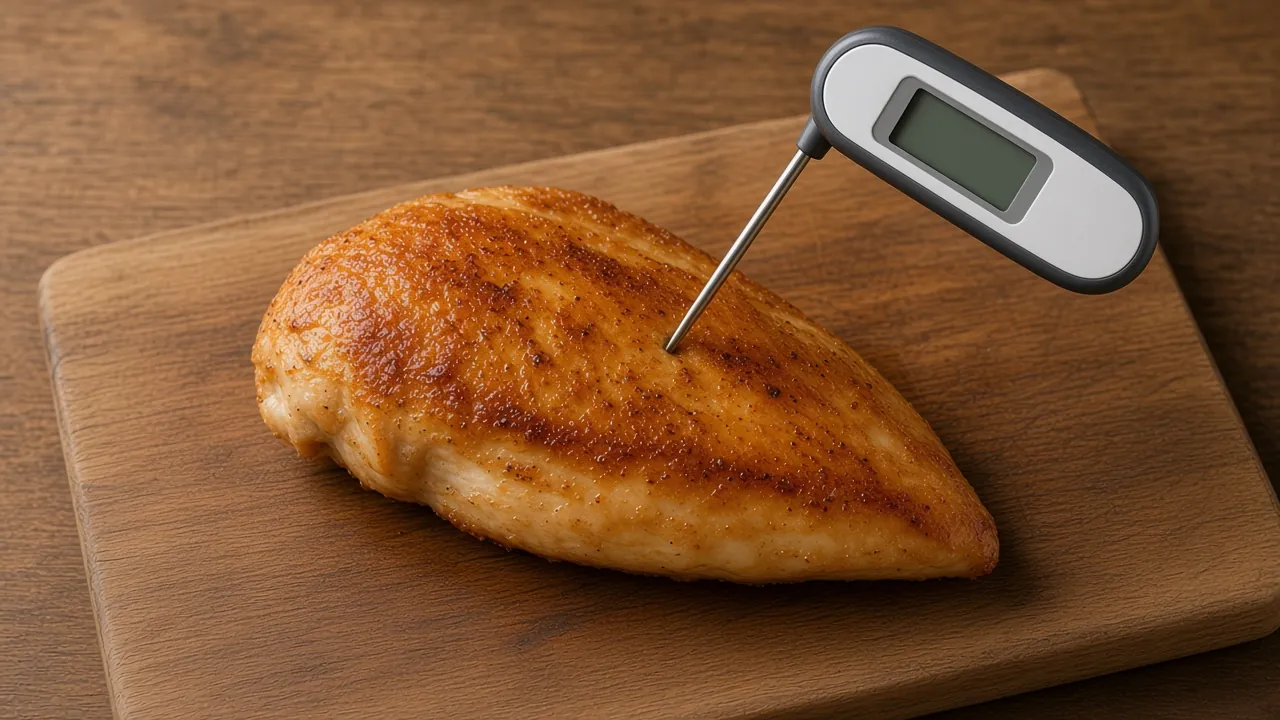
Most of us decide whether chicken or a burger is done by its color: "it's not pink inside anymore." But according to the U.S. Department of Agriculture's Food Safety and Inspection Service (USDA FSIS), color and grill marks are not a reliable sign that food is safe. Ground beef, for example, can turn brown on the outside before it reaches a temperature that destroys harmful bacteria. The only reliable way to know is a food thermometer. This guide covers which internal temperature counts as safe for each type of food, where to insert the thermometer, how to check that it's accurate, and which type suits your kitchen.
This is general food safety information, not medical advice. Pregnant women, infants and toddlers, older adults and people with weakened immune systems are more vulnerable to foodborne illness. When in doubt, consult a doctor or a registered dietitian.
Why color isn't enough
FSIS separates "doneness" (texture, appearance and juiciness) from safety. If you rely only on visual cues, you might overcook food until it's dry, or undercook it and get sick. In a USDA study, 21% of participants relied on color and grill marks to decide their burger patties were cooked. According to FSIS, a patty cooked to 71°C (160°F), as measured with a thermometer, is safe regardless of its color.
Another point from the same page: most pathogens are destroyed between 60°C and 74°C (140–165°F). The numbers in the table below are the safe *minimum* for each food group. You can cook to a higher temperature if you prefer your food more done.
Safe internal temperature chart
According to the chart on FoodSafety.gov (the U.S. government's food safety website), these are the minimum internal temperatures:
| Food | Minimum internal temperature |
|---|---|
| Chicken, turkey and all other poultry (whole, breasts, legs, wings, ground, and stuffing inside the bird) | 74°C (165°F) |
| Ground beef, veal, lamb and goat, and sausages | 71°C (160°F) |
| Steaks, roasts and chops of beef, veal, lamb and goat | 63°C (145°F) + at least 3 minutes rest |
| Fish (whole or fillet), such as salmon, tuna, tilapia, cod or trout | 63°C (145°F), or until the flesh is no longer translucent and separates easily with a fork |
| Egg dishes (frittata, quiche) | 71°C (160°F) |
| Plain eggs | Until yolk and white are firm |
| Casseroles (with or without meat) | 74°C (165°F) |
| Leftovers of any kind, when reheating | 74°C (165°F) |
What is rest time? According to FoodSafety.gov, some meats need to rest after cooking, because during that time the innermost parts keep cooking until they're safe. For a beef steak or roast, take it off the heat at 63°C and wait at least three minutes before cutting.
Where to insert the thermometer
Even an accurate thermometer gives a wrong reading in the wrong spot. According to FSIS:
- In the thickest part, away from bone, fat or gristle.
- Thin foods (patties, thin chicken breasts, sausages): insert the thermometer through the side until the tip reaches the center. To avoid burning your fingers, move the piece from the pan or grill to a clean plate and measure there.
- Whole poultry: check in three places, the innermost part of the thigh, the innermost part of the wing and the thickest part of the breast, avoiding the bone. If you stuff the bird, the center of the stuffing must also reach 74°C. For optimum safety, FSIS advises not stuffing whole poultry.
- Large or irregularly shaped roasts: measure in several places.
- Egg dishes: in the center and in several spots, because ovens have hot spots.
- Several pieces on one tray: check each one, since pieces of different sizes reach temperature at different times.
Also read the manufacturer's instructions: they tell you how deep the thermometer has to go to give an accurate reading.
How to check your thermometer is accurate (calibration)
According to FSIS, most food thermometers are accurate to within about 1–2°C (2–4°F), but it's worth checking from time to time. The method recommended for most thermometers is ice water:
- Fill a large glass with ice cubes, add drinking water and stir well.
- Immerse the stem at least 5 cm (2 inches) deep, without touching the sides or bottom.
- Wait at least 30 seconds and read it without taking it out of the water.
- It should read 0°C (32°F). If not, adjust it according to the manufacturer's instructions (some have a calibration nut or dial). If it can't be adjusted and it's off, it's probably time to replace it.
You can also test in boiling water (100°C at sea level), but FSIS notes that water boils at a lower temperature at high altitude, so FSIS calls the ice water method the best for most thermometers.
Which type of thermometer to choose
FSIS lists several common types. These are the main ones for a home kitchen:
- Digital instant-read (thermistor): reads in about 10 seconds and works for both thin and thick foods. It doesn't stay in the food while cooking; check near the end of the cooking time.
- Thermocouple: the fastest, 2–5 seconds, good for checking several spots. Usually more expensive.
- Oven cord thermometer: the probe stays in the food and the display unit stays outside the oven, so you don't have to open the door. It beeps when the set temperature is reached.
- Wireless / smart: the probe stays in the food and sends readings over Bluetooth or Wi-Fi to your phone, with live updates and alerts. According to FSIS this lets you focus on other dishes without checking constantly, but it costs more. We reviewed one such model in our article on the MEATER Pro thermometer.
- Dial (bimetal): readily available in stores, but it averages the temperature along 5–6 cm of the stem, so it's not suitable for thin foods.
- Candy / deep-fry thermometer: for the high temperatures of oil and syrup, not for checking meat.
Cleaning and storage: according to FSIS, wash with hot, soapy water or as the manufacturer instructs; most thermometers shouldn't be fully immersed. Store the sharp probe in its sheath, and don't leave a thermometer in food while cooking unless it's designed for that (some models have plastic faces that can melt).
A thermometer, plus three habits
A thermometer is only one part of food safety. FSIS also lists eating undercooked meat, poultry, eggs and seafood, leaving perishable food between 4°C and 60°C (40–140°F) for more than two hours, and poor handwashing as key risk factors for foodborne illness. Pair your thermometer with:
- Thawing meat and poultry safely before cooking.
- Keeping raw and cooked food apart, including cleaning the probe between raw meat and a finished dish.
- Storing and reheating leftovers properly, to 74°C.
Where KitchenAppes fits in
In KitchenAppes cooking mode each step appears on its own on the screen, so it's easy to pause at a "check the temperature" step without losing your place in the recipe. You can save the chicken, fish and patty dishes you make again and again in one place, and Smart Chef can suggest a recipe from the ingredients you already have at home. The check itself is always done with the thermometer.
Sources
- FoodSafety.gov (U.S. Department of Health and Human Services): Cook to a Safe Minimum Internal Temperature
- USDA Food Safety and Inspection Service: Food Thermometers
KitchenAppes
Download the app