Beginner Homemade Bread: Yeast, Kneading, Rising, Baking
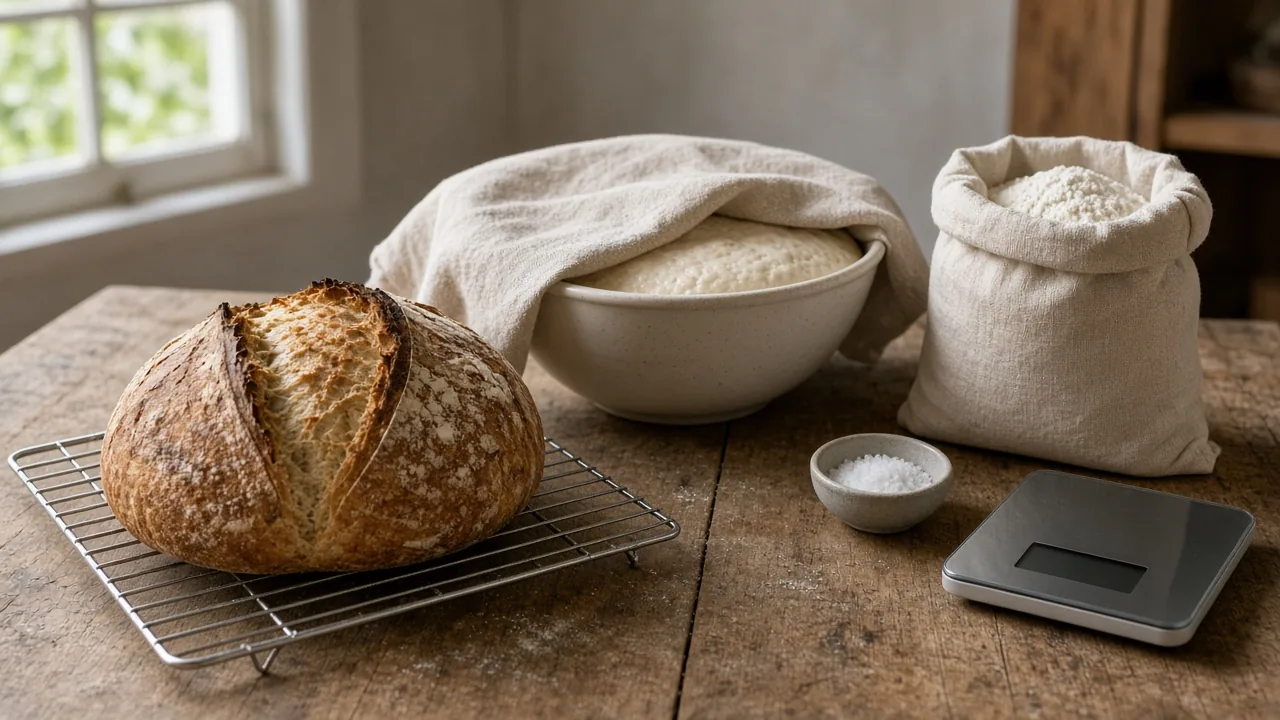
The smell of bread coming out of the oven is hard to argue with. Even so, many people never try it even once, because it seems to involve a secret: "How long do I knead?", "How do I know the dough has risen?", "Why did my bread come out dense?". The good news: a basic loaf is made from just four ingredients, and most of the "secrets" are signs you learn to recognise. In this article we go step by step, following the explanations of King Arthur Baking — an American flour and baking company that publishes detailed baking guides — and the food safety guidance of the U.S. Centers for Disease Control and Prevention (CDC).
A quick note before you start: bread made from wheat, barley or rye flour contains gluten. According to the NHS, gluten is found in any food that contains wheat, barley or rye, so anyone with coeliac disease needs a dedicated gluten-free recipe and should follow the personal advice they have been given.
Four ingredients and one ratio
A basic yeast bread is flour, water, salt and yeast. Bakers describe the ratio between them in "baker's percentages": the weight of the flour is always 100%, and every other ingredient is calculated as a percentage of the flour weight. King Arthur gives an example of a simple formula:
| Ingredient | Baker's % | Weight |
|---|---|---|
| Flour | 100% | 500 g |
| Water | 66% | 330 g |
| Salt | 2% | 10 g |
| Yeast | 1.2% | 6 g |
The advantage: you can scale the batch up or down without breaking the ratio, and compare recipes at a glance. According to King Arthur, there are no firm rules for how much water, fat or sugar a bread should contain — each baker and each style sets their own; salt is the exception and is generally between 1.8% and 2.2% of the flour weight.
Weigh, don't measure in cups. A cup of flour can weigh different amounts depending on how you fill it, and in bread the difference shows. If your recipe is in cups, we explained how to convert in How many grams in a cup?, but a simple kitchen scale saves all the guesswork.
Flour and water
When wheat flour meets water and is kneaded, its proteins form gluten — a stretchy web that traps the carbon dioxide released by the yeast, which is what lets bread rise and hold its shape. That is why swapping the flour in a familiar recipe (for example, for a flour with more or less protein) changes how the dough looks and feels.
The amount of water is called "hydration" — the weight of the water divided by the weight of the flour. According to King Arthur, a dough of around 60% is considered low hydration, or "stiff", while doughs above 80% are high hydration, soft and slack. Wholemeal and high-protein flours are "thirstier" and absorb more water, so when you swap some white flour for wholemeal you may need to add a little water. We covered the difference between whole and refined grains in Whole Grains vs. Refined Grains. For beginners, a medium-hydration dough like the one in the table is a comfortable starting point.
Which yeast
- Instant yeast. Small granules that dissolve quickly. Mix them straight into the flour, without dissolving them in water first.
- Active dry yeast. According to King Arthur, it is now made with a gentler process, so it no longer has to be dissolved in warm water first either. It gets going more slowly: if a recipe with instant yeast says "let rise until doubled, about 1 hour", mentally add 15–20 minutes. Over a long 2–3 hour rise it catches up with instant yeast.
- Amount: according to King Arthur, you can swap one for the other using exactly the same amount.
- Fresh (compressed) yeast: according to King Arthur's professional guide, to convert fresh yeast to active dry yeast multiply the amount by 0.4, and to instant yeast by 0.33. It is still best to follow the manufacturer's conversion ratio if one is given. Instant yeast is sensitive to ice or ice-cold water.
Salt: not just flavour
According to King Arthur, salt does three jobs in dough: it adds flavour (bread without salt tastes flat), it strengthens the gluten web (without salt the dough is slack and sticky and the loaf rises less), and it slows the yeast, helping to control the pace of fermentation. So you don't "skip" the salt in bread — but you don't increase it beyond the recipe either.
This matters for health too: the World Health Organization (WHO) notes that in many countries bread is one of the foods that contributes a lot of salt, simply because it is eaten so often. WHO advises adults to have less than 5 grams of salt a day. We wrote about salt in home cooking in Salt in home cooking.
Kneading: how to know it's enough
Recipes say "knead until smooth and elastic", which is hard to interpret the first time. King Arthur suggests the windowpane test:
- Tear off a piece of dough about the size of a ping-pong ball.
- Flatten it between your fingers like a tiny pizza, let it rest for a couple of minutes, then flatten it some more.
- Gently pull on opposite ends.
If the dough tears almost immediately, the gluten is not developed yet. If you can stretch it thin enough to see light through it, it is well developed. According to King Arthur, this is not a pass/fail test: for a bread that rises in the bowl for only about an hour before shaping, you want the gluten almost fully developed, just starting to show light; for a dough that will rise for many hours (including in the fridge), a dough that stretches a little and then tears is fine — time keeps strengthening the gluten. In wholemeal dough the bran cuts through the gluten strands, so a "windowpane" will be hard to reach, and it is not worth chasing.
Rising: two rises, two signs
According to King Arthur, most bread recipes include two rises: the first in the bowl after kneading, and the second after the loaf is shaped, for example in a tin. The rising time in a recipe is a guideline, not a rule: water and air temperature, humidity, the size of the dough and the container all change the pace. In a warm, humid kitchen dough rises faster; in cold, dry air, more slowly.
- First rise — doubled in volume. The simple way: a straight-sided container and a strip of masking tape where the dough starts. You will clearly see when it has doubled.
- Second rise in a loaf tin — many recipes recommend baking once the dough has risen about 2.5 cm (1 inch) above the rim of the tin (using the tin size given in the recipe).
- The poke test — especially for free-form loaves and rolls: flour a finger and press about 2.5 cm (1 inch) into the dough. If the dent stays, it is ready to bake. If it springs back, give it more time. If the dough feels fragile or collapses when you touch it, it has over-risen.
Under- or over-proofing can give a loaf that collapses or has a dense, gummy centre, so start checking at the beginning of the time range in the recipe.
Baking: when is the bread done
The traditional way: take the loaf out, tap the bottom and listen for a hollow sound. The more precise way: a thermometer. In tests published by King Arthur, most loaves and rolls were done when the centre reached 190°F, about 88°C. A sandwich loaf baked to 88°C came out softer and moister than one baked to about 96°C (205°F). Some breads — baguettes, for example — need a higher internal temperature, and some recipes (such as rye or gluten-free bread) give a higher target temperature; in that case, follow the recipe. A digital thermometer you already have in the kitchen will work here too — we wrote about it in our Food Thermometer Guide.
Oven temperature and baking time are set by the recipe, because they depend on the size of the loaf, the type of dough and your oven.
Safety: don't taste raw dough
According to the CDC, most flour is raw — it has not been treated to kill germs such as E. coli and Salmonella, and grinding or bleaching the flour does not kill them. Germs are killed only by baking or cooking. So the CDC advises:
- don't eat or taste unbaked dough or batter — including dough for bread, pizza or tortillas;
- don't let children play with dough made from raw flour, including craft dough;
- keep flour and dough away from ready-to-eat foods — flour is a powder and spreads easily;
- wash your hands with soap and water after handling flour or dough, and wash bowls, utensils and surfaces with hot, soapy water.
After the oven: cooling, storing and freezing
- Cool completely on a rack before wrapping. According to King Arthur, wrapping warm bread traps steam that turns into condensation and encourages mould.
- At room temperature: bread wrapped in a plastic bag or foil stays soft for a few days; cloth "breathes" and dries the bread faster. According to King Arthur, about 16–27°C (60–80°F) is suitable, somewhere dark and out of the sun — a cupboard, a drawer or a bread box.
- Not in the fridge: according to King Arthur, the fridge dries bread out and makes it go stale faster; if you do keep bread there, toast or reheat it before eating.
- In the freezer: up to about three months, well wrapped in several airtight layers (gluten-free bread — best finished within a month). It helps to slice first and pack 2–4 slices per bag. Thawing: a whole loaf — about three hours at room temperature, still wrapped; slices — under half an hour, or straight into the toaster. More on freezing in Freezing Food at Home.
Where KitchenAppes fits in
Keep the bread recipe that worked for you in the KitchenAppes recipe book, with the amounts and times that worked in your kitchen. In cooking mode one step is shown at a time, you can keep the screen on, and you can start a timer from inside the step — handy when your hands are in the dough. And if you have bread left over from a few days ago, Smart Chef can suggest a recipe from the ingredients you already have at home. The app does not weigh anything, does not calculate baker's percentages, does not check your dough and does not control your oven.
In short
- Basic bread = flour, water, salt and yeast; weigh rather than measure in cups.
- Salt — about 2% of the flour weight; instant and active dry yeast can be swapped in the same amount.
- Kneading: the windowpane test. First rise: doubled in volume. Second rise: the poke test, or 2.5 cm above the tin.
- Baking: most breads are done at about 88°C in the centre, unless the recipe says otherwise.
- Don't taste raw dough; cool completely, store at room temperature or in the freezer — not in the fridge.
Sources
- King Arthur Baking. What is baker's math, and how can I use it in my everyday bread baking? (April 28, 2022). Checked 25 November 2026
- King Arthur Baking. Hydration in bread dough, explained (January 11, 2023). Checked 25 November 2026
- King Arthur Baking. Active dry vs. instant yeast: Why we prefer instant (August 15, 2022). Checked 25 November 2026
- King Arthur Baking (Pro). Yeast. Checked 25 November 2026
- King Arthur Baking (Pro). Salt. Checked 25 November 2026
- King Arthur Baking. What is the windowpane test for bread dough? (October 14, 2022). Checked 25 November 2026
- King Arthur Baking. How to tell if bread dough has risen enough (August 22, 2022). Checked 25 November 2026
- King Arthur Baking. Using a thermometer with yeast bread (April 7, 2017). Checked 25 November 2026
- King Arthur Baking. The best way to store yeast bread (July 8, 2020). Checked 25 November 2026
- King Arthur Baking. How can I freeze my bread? (And defrost it, too!) (December 20, 2023). Checked 25 November 2026
- CDC. Raw Flour and Dough (Nov. 24, 2025). Checked 25 November 2026
- WHO. Healthy diet (Fact sheet, updated 26 January 2026). Checked 25 November 2026
- NHS. Coeliac disease. Checked 25 November 2026
KitchenAppes
Download the app