Food and Mood: What the Research Actually Says
This is general information, not personal medical or nutrition advice. Food is not a treatment for depression, and a recipe or a vitamin does not replace a doctor or a mental-health professional. If low mood lasts more than two weeks, or if you have thoughts of self-harm, contact a doctor or a mental-health professional, or a local emergency service or helpline. In Israel you can also call ERAN, an emotional first-aid helpline, at 1201 (24/7): https://www.eran.org.il/en/. ERAN does not replace professional treatment.
Some days cooking feels like too much. Some days the plate itself seems to change how you feel after a meal. Whether food and mood are connected is a fair question, and the careful answer is: there is a researched link, but it is not simple, and it does not replace care. In this article we go through what the evidence actually shows, what is still unproven, and how to think about everyday meals — without medical promises. We covered the World Health Organization's four principles for a balanced diet (adequacy, balance, moderation and diversity) in Balanced nutrition in a weekly menu.
What the research actually shows — and what it does not prove
A 2020 review in The BMJ (Firth and colleagues) sums it up this way: healthy eating patterns, including the Mediterranean diet, are associated with better mental health than a "Western" pattern rich in processed food. But the relationship is complicated, and reverse causality is a real risk: when we feel low we change what we choose to eat, appetite shifts, and some medicines themselves affect appetite. A study that finds a statistical link between a menu and mood does not prove that the menu is the cause.
That is why this article keeps two kinds of evidence apart. The first is observational follow-up research, which can show association but not cause. The second is randomised trials, which are still few and often small. Even a positive trial needs its limits read in full.
The Mediterranean pattern: what has been tested, and what is still open
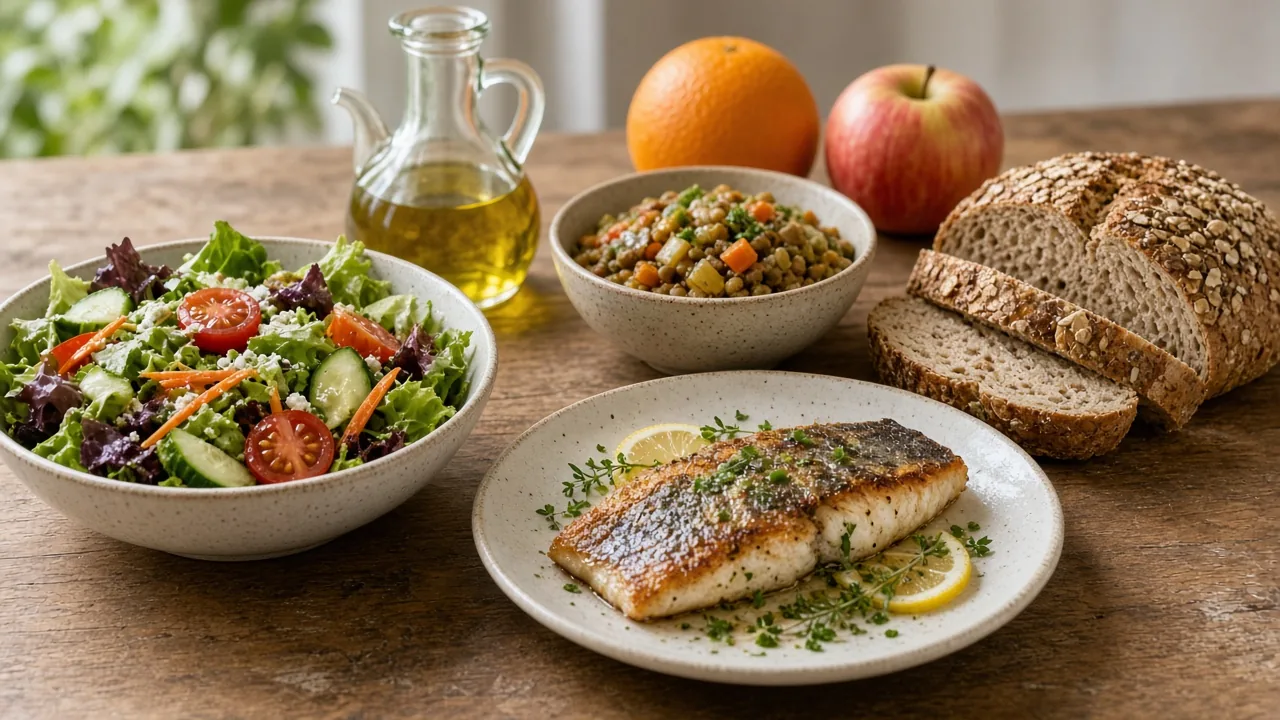
The Mediterranean-style pattern, as described by the Harvard T.H. Chan School of Public Health Nutrition Source and in the BMJ review, is mainly plant-based: whole grains, olive oil, fruit, vegetables, legumes, nuts, herbs and spices in everyday eating; fish as the preferred animal protein, often at least twice a week; poultry, eggs and dairy in smaller amounts; and red meat less often. It is not a weight-loss "diet". It is a way to build a plate across the week. We have written about whole grains, vegetables and fruits every day and legumes in the home kitchen.
One of the better-known trials in this field is SMILES, published in 2017: a 12-week randomised trial in Australia among 67 adults with moderate to severe major depression. Fifty-five of the participants were already receiving medication, psychotherapy, or both; the dietary programme was an addition to treatment, not a replacement for it. One group had seven sessions with a dietitian following a modified Mediterranean pattern; the other received social support on the same schedule. The diet group improved more on the symptom scale the researchers used, and remission was 32.3% (10 of 31) versus 8.0% (2 of 25) in the control group. The authors themselves stress that the sample was small, participants could not be blinded to the type of support they received, the recruitment advertising had to disclose that the programme was about diet, recruitment was difficult, and the measured effect may have been inflated by the sample size. People were also enrolled on the basis of an already poor diet, which limits how far the finding can be generalised to everyone with depression. This is preliminary and encouraging evidence, not proof that "food treats depression".
In 2024, Nutrition Reviews published a meta-analysis of five randomised trials, with 1,507 participants (mean age range 22.0 to 53.3 years) who had depressive symptoms of varying severity. According to the abstract, Mediterranean-style interventions reduced symptoms more than control conditions (standardised mean difference −0.53; 95% confidence interval −0.90 to −0.16). But heterogeneity between trials was high, the certainty of the evidence was rated low, and the prediction interval (−1.86 to 0.81) also included the possibility of no effect. The authors write that larger, longer, higher-quality trials are still needed. The full paper is behind a paywall, so we relied on the abstract.
One more caveat from the BMJ review: a large trial found no significant benefit from a behavioural intervention promoting a Mediterranean diet in adults with subclinical depressive symptoms. In plain terms, not every menu change, and not every kind of low mood, produces the same result.
Blood sugar, and regular meals
The brain needs a steady supply of energy, much of it from glucose in the blood. According to the same BMJ review, a pattern rich in refined carbohydrates and sugars — that is, a high glycaemic load — has been associated in longitudinal research with a higher incidence of depressive symptoms. In controlled experiments, exposure to a high glycaemic-load diet increased such symptoms even in healthy volunteers. One proposed mechanism is sharp rises and falls in blood glucose, which can trigger stress hormones and go along with irritability, anxiety or hunger. That is a possible pathway, not proof that every sweet snack "causes depression".
The British Dietetic Association writes that breakfast and regular meals that include some carbohydrate help keep enough glucose in the blood, and that feeling well also rests on healthier carbohydrates at regular times. According to the same page, irregular eating or a very restrictive diet can leave blood glucose too low, which may go along with weakness, tiredness and feeling "fuzzy minded". That is general everyday guidance, not a rule that "three meals a day treat low mood".
In the kitchen this translates into simple choices, not a glycaemic-index calculation at every bite: prefer whole grains, legumes, vegetables and fruit; combine a carbohydrate with protein or some fat; skip fewer meals when you have a choice; and do not build the day mainly on sweet baked goods and sugary drinks. We covered free sugars in Free sugars, and fibre that helps a meal "hold" longer in Dietary fibre.
The gut and mood: what is still unproven
There has been a lot of talk in recent years about a link between the gut and the brain. The BMJ review describes promising evidence: major depression is associated with changes in the microbiome, and a diet rich in fibre, polyphenols and unsaturated fat (as in a Mediterranean pattern) can favour microbes that produce anti-inflammatory metabolites. But the authors state clearly that no causal relationship has been established between specific microbes, or their metabolites, and complex human emotions; nor has it been shown that a diet-driven change in the microbiome improves clinical depression, or in what time frame. That is why we do not recommend a probiotic supplement, a "gut cleanse", or a recipe as treatment.
What is not proven
To leave no doubt:
- No food, recipe, vitamin or supplement has been shown to be a treatment for depression, or a substitute for a doctor or a therapist.
- When a trial finds improvement, it is usually as an addition to existing care, in small samples, or with low-certainty evidence.
- Vitamin D supplements, according to the U.S. National Institutes of Health, did not prevent depression and did not ease it in clinical trials. We cover the vitamin itself in Vitamin D in the Kitchen.
- For omega-3, vitamin B12 and folate — what is on the plate, what the research says with caution, and when too much can harm — see Omega-3, Vitamin D, B12 and Folate: What's on the Plate.
- The causes of depression are many and varied, and they often exist regardless of what is on the plate. The BMJ review also stresses that the food-and-mood link should never be used to judge or blame someone for what they eat.
Meal ideas
General KitchenAppes ideas, not a medical menu and not "medicine on a plate":
- Oven-baked fish with vegetables and olive oil, for example salmon or trout, once or twice a week. For a tender salmon idea, see hot-oil curing for fish.
- Lentil soup or a chickpea stew with whole-grain bread and a salad, when you want a warm meal that does not require special skill.
- Shakshuka or an egg on whole-grain bread, with vegetables and fruit afterwards.
- Oats or yogurt with walnuts and fruit, on a morning with little energy.
- A legume salad made ahead and kept in the fridge, for a day when cooking itself feels too heavy.
Where KitchenAppes fits in
Keep the fish, legume, whole-grain and vegetable recipes you return to in one place in the KitchenAppes recipe book. And if you have lentils, eggs and vegetables at home with no clear plan, Smart Chef can suggest a recipe from what you already have. The app does not calculate vitamins, does not measure mood, and does not replace medical or nutrition advice.
Sources
- Firth J, Gangwisch JE, Borsini A, Wootton RE, Mayer EA. Food and mood: how do diet and nutrition affect mental wellbeing? BMJ 2020;369:m2382 (published 29 June 2020; checked 13 November 2026)
- Jacka FN et al. A randomised controlled trial of dietary improvement for adults with major depression (the ‘SMILES’ trial). BMC Medicine 2017 (published 30 January 2017; a 28 December 2018 correction concerns a recruitment method only). Checked 13 November 2026
- Bizzozero-Peroni B et al. The impact of the Mediterranean diet on alleviating depressive symptoms in adults: a systematic review and meta-analysis of randomized controlled trials. Nutrition Reviews 2025;83(1):29–39 (published online 14 January 2024). Abstract only; the full paper is behind a paywall. Checked 13 November 2026
- Harvard T.H. Chan School of Public Health, The Nutrition Source. Diet Review: Mediterranean Diet (Last reviewed April 2023). Checked 13 November 2026
- World Health Organization. Healthy diet (26 January 2026). Checked 13 November 2026
- NHS Every Mind Matters. Low mood and depression and Top tips to improve mental wellbeing. Checked 13 November 2026
- British Dietetic Association. Food and mood. Checked 13 November 2026; no update date was found on the page
- NIH Office of Dietary Supplements: Vitamin D — Fact Sheet for Consumers (Updated November 8, 2022). Checked 13 November 2026
- ERAN. ERAN services — helpline 1201, 24/7. Checked 13 November 2026
KitchenAppes
Download the app