Omega-3, Vitamin D, B12 and Folate: What's on the Plate
This is general information, not personal medical or nutrition advice. A vitamin or a food is not a treatment for depression, and does not replace a doctor or a mental-health professional. We do not recommend any supplement, dose or brand. If low mood lasts more than two weeks, or if you have thoughts of self-harm, contact a doctor or a mental-health professional, or a local emergency service or helpline. In Israel you can also call ERAN, an emotional first-aid helpline, at 1201 (24/7): https://www.eran.org.il/en/. ERAN does not replace professional treatment.
Four nutrients come up often in conversations about food and everyday mood: omega-3, vitamin D, vitamin B12 and folate. This article looks at what is on the plate, who may get too little, what the research says with caution about mood, and when excess or a medicine interaction calls for care. We covered the broader link between diet and mood — and what is not proven — in Food and Mood: What the Research Actually Says. Vitamin D already has its own kitchen article, so we do not repeat its tables here.
The figures in the tables are official values from the U.S. National Institutes of Health Office of Dietary Supplements (NIH ODS), usually based on U.S. Department of Agriculture data. A 3-ounce serving is about 85 g, and a "cup" is a U.S. cup. Fortification and serving sizes vary by country and by product — check the label for the amount in the food you actually buy.
Omega-3: what it is, and how much is recommended
According to NIH ODS, the three omega-3 fatty acids most often studied are alpha-linolenic acid (ALA), found mainly in plant oils, and EPA and DHA, found in fish and seafood. The body converts very little ALA into EPA and then DHA (according to the professional fact sheet, reported conversion rates are less than 15%). So the practical way to raise EPA and DHA levels is to eat them directly, mainly from fatty fish.
There is no Recommended Dietary Allowance (RDA) for omega-3s, except for ALA. The amounts below are Adequate Intakes (AI) according to NIH ODS, in grams per day:
| Age / stage | Men | Women | Pregnancy | Lactation |
|---|---|---|---|---|
| Birth to 12 months (total omega-3s) | 0.5 g | 0.5 g | ||
| Children 1 to 3 (ALA) | 0.7 g | 0.7 g | ||
| Children 4 to 8 (ALA) | 0.9 g | 0.9 g | ||
| Children 9 to 13 (ALA) | 1.2 g | 1.0 g | ||
| Teens 14 to 18, and adults (ALA) | 1.6 g | 1.1 g | 1.4 g | 1.3 g |
Selected examples from Table 2 of the professional fact sheet (U.S. cup; 3 ounces ≈ 85 g). Values are grams per serving:
| Food | ALA | DHA | EPA |
|---|---|---|---|
| Flaxseed oil, 1 tbsp | 7.26 | ||
| Chia seeds, 1 ounce (about 28 g) | 5.06 | ||
| English walnuts, 1 ounce (about 28 g) | 2.57 | ||
| Atlantic salmon, farmed, cooked, 3 ounces | 1.24 | 0.59 | |
| Atlantic salmon, wild, cooked, 3 ounces | 1.22 | 0.35 | |
| Atlantic herring, cooked, 3 ounces | 0.94 | 0.77 | |
| Canola oil, 1 tbsp | 1.28 | ||
| Sardines, canned in tomato sauce, drained, 3 ounces | 0.74 | 0.45 | |
| Atlantic mackerel, cooked, 3 ounces | 0.59 | 0.43 | |
| Rainbow trout, wild, cooked, 3 ounces | 0.44 | 0.40 | |
| Light tuna, canned in water, 3 ounces | 0.17 | 0.02 | |
| Egg, cooked, 1 | 0.03 |
Three practical points: fatty fish lead by a wide margin for EPA and DHA; walnuts, flax, chia and canola oil mainly provide ALA; and an egg contributes very little. We have written about choosing cooking oils in Which oil should you cook with?, and about fish in hot-oil curing for fish.
According to the consumer fact sheet, a classic omega-3 deficiency is very rare in the United States. There is no known blood cut-off below which certain functions are impaired, and we do not recommend a test or a supplement without a doctor.
Omega-3 and mood — with caution
According to the NIH ODS professional fact sheet, a 2016 meta-analysis found a 17% lower risk of depression with higher fish intake. That is an association from observational research, not proof of cause. A 2015 Cochrane review of 26 studies found insufficient evidence to determine whether omega-3 supplements are beneficial for major depression in adults. The authors did find a small-to-modest effect on symptoms, but judged it not clinically significant. In other words: fish on the plate is a reasonable dietary choice, not a "treatment for depression".
When omega-3s call for care
There is no official tolerable upper intake level (UL) for omega-3s. According to the consumer fact sheet, the U.S. Food and Drug Administration recommends no more than 5 g per day of EPA and DHA combined from dietary supplements. High supplement doses have been linked, among other effects, to an unpleasant taste, heartburn, nausea and gastrointestinal discomfort. According to the professional sheet, two large clinical trials found that 4 g per day of an omega-3 supplement for several years slightly increased the risk of atrial fibrillation in people with cardiovascular disease or at high risk of it. Fish-oil supplements at high doses may also affect clotting when taken with warfarin or similar anticoagulants. Tell your doctor and pharmacist about every supplement and medicine you take. We do not recommend any supplement, dose or brand.
Vitamin D: a link to the existing article, without repeating it
Very few foods naturally contain vitamin D, and the body can also make it when skin is exposed to the sun. How much is recommended by age, which foods provide it, what the sun does and does not do, who may get too little, and when excess is harmful — all of that is in Vitamin D in the Kitchen.
For this article, one line from the NIH ODS consumer fact sheet is enough: some studies have found a link between low blood levels and a higher risk of depression, but clinical trials show that vitamin D supplements do not prevent depression and do not ease its symptoms. So there is no promise here either that a supplement or a recipe "treats mood".
Vitamin B12: how much, and where on the plate
According to NIH ODS, vitamin B12 is needed for the development and function of the central nervous system, for red blood cell formation, and for DNA synthesis. It occurs naturally in animal foods — fish, meat, poultry, eggs and dairy — and not in plant foods unless they are fortified. Recommended Dietary Allowances (RDA), in micrograms (mcg):
| Age / stage | Amount per day |
|---|---|
| Birth to 6 months (Adequate Intake) | 0.4 mcg |
| Infants 7 to 12 months (Adequate Intake) | 0.5 mcg |
| Children 1 to 3 | 0.9 mcg |
| Children 4 to 8 | 1.2 mcg |
| Children 9 to 13 | 1.8 mcg |
| Age 14 and older, including adults | 2.4 mcg |
| Pregnancy | 2.6 mcg |
| Lactation | 2.8 mcg |
Selected examples from Table 2 of the professional fact sheet (3 ounces ≈ 85 g):
| Food | B12 per serving |
|---|---|
| Beef liver, pan fried, 3 ounces | 70.7 mcg |
| Clams (without shells), cooked, 3 ounces | 17 mcg |
| Atlantic salmon, cooked, 3 ounces | 2.6 mcg |
| Light tuna, canned in water, 3 ounces | 2.5 mcg |
| Ground beef, 85% lean, cooked, 3 ounces | 2.4 mcg |
| 2% milk, 1 cup | 1.3 mcg |
| Plain nonfat yogurt, 6-ounce container | 1.0 mcg |
| Cheddar cheese, 1½ ounces | 0.5 mcg |
| Whole egg, cooked, 1 large | 0.5 mcg |
| Banana, whole-wheat bread, beans or spinach | 0 |
The body stores B12 for a long time, so deficiency symptoms can take years to appear. According to NIH ODS, deficiency can cause fatigue, megaloblastic anemia, neurological changes (such as numbness and tingling in the hands and feet) and other symptoms; the nerve changes can appear without anemia, and early diagnosis matters to avoid irreversible damage. Diagnosis and treatment belong with a doctor, not with an article.
Who may get too little B12, and what is known about mood
According to NIH ODS, groups more likely to have a deficiency include:
- Older adults — in part because of lower stomach acid and less of the "intrinsic factor" needed for absorption.
- Pernicious anemia — an autoimmune condition that prevents absorption even when the diet contains enough B12.
- Gastrointestinal disorders — such as celiac disease, and in some cases Crohn's disease.
- Gastrointestinal surgery — including stomach surgery or weight-loss surgery.
- Vegetarians and vegans — because natural food sources are animal foods; fortified foods (for example fortified nutritional yeast, according to the label) can reduce the risk.
- Breastfed infants of vegan mothers — B12 stores can be very limited. This needs medical follow-up.
Some studies have found an association between B12 deficiency, or low B12 intakes, and depression. That is an association, not proof that a supplement or a recipe treats depression. Medicines such as proton-pump inhibitors (for example omeprazole) and metformin can reduce absorption. There is no tolerable upper intake level for B12, because its potential for toxicity is low; that is still not a reason to start a supplement without a doctor.
Folate: how much, and where on the plate
Folate is a water-soluble B vitamin that occurs naturally in food. Folic acid is the synthetic form added to fortified foods and to most supplements. According to NIH ODS, folate takes part in the synthesis of DNA and RNA and in amino-acid metabolism. Recommended amounts are expressed as dietary folate equivalents (DFE), because folic acid is absorbed more readily than the folate naturally present in food:
| Age / stage | Amount per day |
|---|---|
| Birth to 6 months (Adequate Intake) | 65 mcg DFE |
| Infants 7 to 12 months (Adequate Intake) | 80 mcg DFE |
| Children 1 to 3 | 150 mcg DFE |
| Children 4 to 8 | 200 mcg DFE |
| Children 9 to 13 | 300 mcg DFE |
| Age 14 and older, including adults | 400 mcg DFE |
| Pregnancy | 600 mcg DFE |
| Lactation | 500 mcg DFE |
According to the U.S. National Academies and the U.S. Centers for Disease Control and Prevention, women and adolescents who could become pregnant should obtain 400 mcg of folic acid a day from supplements and/or fortified foods, in addition to the folate in a varied diet, to reduce the risk of neural-tube defects. That is an official U.S. public-health recommendation, not our recommendation of a brand, and not a "treatment for mood". What is right for you is a question for your doctor.
Selected examples from Table 2 of the professional fact sheet:
| Food | Folate per serving (mcg DFE) |
|---|---|
| Beef liver, braised, 3 ounces | 215 |
| Spinach, boiled, ½ cup | 131 |
| Black-eyed peas, boiled, ½ cup | 105 |
| Asparagus, boiled, 4 spears | 89 |
| Brussels sprouts, frozen, boiled, ½ cup | 78 |
| Romaine lettuce, shredded, 1 cup | 64 |
| Avocado, raw, sliced, ½ cup | 59 |
| Broccoli, chopped, frozen, cooked, ½ cup | 52 |
| Kidney beans, canned, ½ cup | 46 |
| Orange, fresh, 1 small | 29 |
| Egg, whole, hard boiled, 1 large | 22 |
Dark leafy greens, legumes, liver and some fruits are good sources. In the United States some grains and breads are fortified with folic acid; in Israel fortification varies by product, so check the label. We have written about vegetables and fruit and about legumes in Vegetables and fruits every day and Legumes in the home kitchen.
Who may get too little folate, and what is known about mood
According to NIH ODS, frank deficiency is uncommon in the United States, but some groups are at higher risk: people with alcohol use disorder (alcohol also impairs absorption); women of childbearing age and pregnant women, because of the higher requirement; people with malabsorptive disorders (such as celiac disease or inflammatory bowel disease); and people with a common variant in the MTHFR gene, which reduces conversion to the active form. Genetic testing and any personal adjustment belong with a doctor.
Folate or B12 deficiency can cause megaloblastic anemia, with weakness, fatigue, difficulty concentrating, irritability and other symptoms. Some studies have found a link between low folate status and depression or a poorer response to antidepressants; others have not. The NIH ODS authors write that more research is needed, and that evidence on folate as an add-on to antidepressant treatment is mixed and in part of low quality. Doses used in some of those trials exceeded the official upper limit, and that is a decision for a doctor only. We do not recommend a supplement as a treatment for mood.
When folate calls for care
There is no upper limit for folate from natural food, because harm from food folate has not been reported. The upper limit applies to the synthetic forms in supplements and fortified foods. For adults, including during pregnancy and lactation, the limit is 1,000 mcg per day of folic acid from supplements or fortification (not in DFE). Large amounts can correct the anemia of B12 deficiency without correcting the nerve damage, so excess may delay a diagnosis. Folate supplements may also interact with methotrexate, with some anti-seizure medicines (such as phenytoin, carbamazepine and valproate) and with sulfasalazine. Tell your doctor and pharmacist about every supplement and medicine you take.
Meal ideas
General KitchenAppes ideas, not a medical menu and not "medicine on a plate":
- Oven-baked salmon or trout with spinach or broccoli and a spoonful of olive oil, once or twice a week.
- A lentil or bean salad with romaine, avocado and orange.
- Shakshuka or an egg on bread, with green vegetables on the side.
- Yogurt or oats with walnuts, if you eat animal foods or fortified products according to the label.
- A label check for plant-based drinks, bread and breakfast cereals: some are fortified with B12, folate or vitamin D, and some are not.
Where KitchenAppes fits in
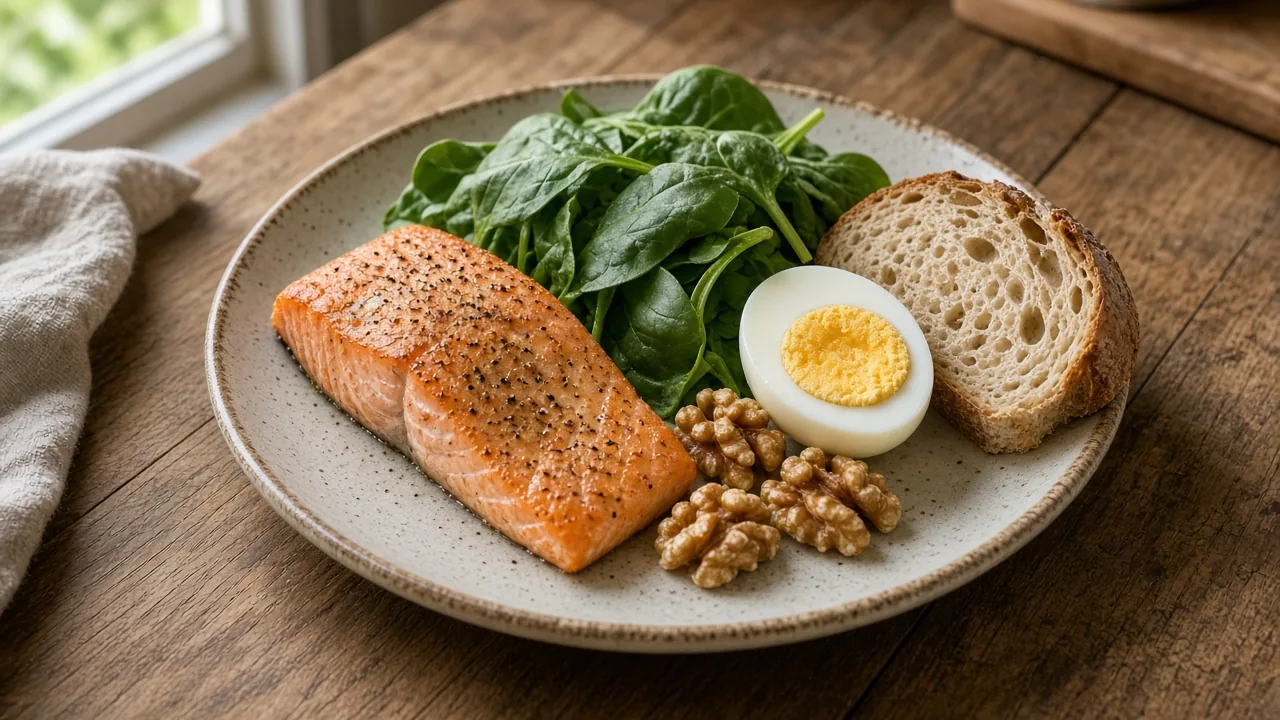
Keep the fish, legume, egg and leafy-green recipes you return to in one place in the KitchenAppes recipe book. And if you have salmon, spinach and eggs at home with no clear plan, Smart Chef can suggest a recipe from what you already have. The app does not calculate vitamins, does not measure mood, and does not replace medical or nutrition advice.
Sources
- NIH Office of Dietary Supplements: Omega-3 Fatty Acids — Fact Sheet for Health Professionals and Fact Sheet for Consumers (consumer sheet: Updated July 18, 2022; professional sheet: Updated August 22, 2025). Checked 13 November 2026
- NIH Office of Dietary Supplements: Vitamin D — Fact Sheet for Consumers (Updated November 8, 2022). Checked 13 November 2026
- NIH Office of Dietary Supplements: Vitamin B12 — Fact Sheet for Health Professionals (Updated July 2, 2025). Checked 13 November 2026
- NIH Office of Dietary Supplements: Folate — Fact Sheet for Health Professionals (Updated November 30, 2022). Checked 13 November 2026
- ERAN. ERAN services — helpline 1201, 24/7. Checked 13 November 2026
KitchenAppes
Download the app