Which oil should you cook with? A simple kitchen fats guide
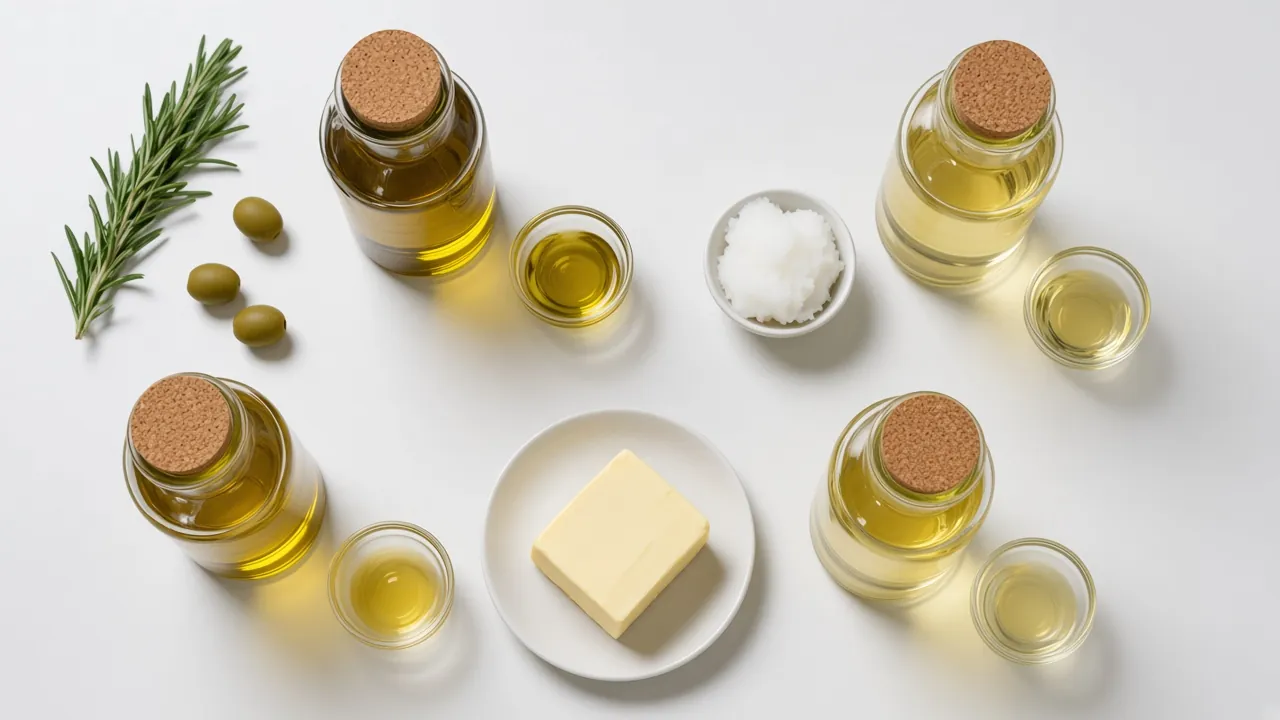
Almost every recipe starts with "heat some oil in a pan." But the shelf holds olive, canola, sunflower, soybean and coconut oil, with butter and margarine right next to them. They're all fat, yet their makeup is very different. In this article we explain the main types of fat, what nutrition experts say about them, and how that turns into simple decisions in your kitchen.
This is general information, not medical advice. If you have a blood lipid problem, heart disease or personal dietary instructions, follow your doctor or dietitian.
Four types of fat, in brief
According to The Nutrition Source, the nutrition website of the Harvard T.H. Chan School of Public Health, every food that contains fat has a mix of several types:
- Monounsaturated fat: liquid at room temperature. Found in high concentrations in olive, peanut and canola oils, avocados, almonds, hazelnuts, and pumpkin and sesame seeds.
- Polyunsaturated fat: also liquid. Found in sunflower, corn, soybean and flaxseed oils, walnuts, flax seeds and fish. Omega-3 fatty acids belong to this group, and the body can't make them on its own.
- Saturated fat: found mainly in animal foods such as meat, cheese and butter, and in a few plant sources: coconut, coconut oil and palm oil.
- Trans fat: made mostly by an industrial process that hardens vegetable oils (partial hydrogenation), and found naturally in small amounts in beef and dairy fat.
What the experts say
Harvard sums up that unsaturated fats are considered beneficial fats, and that most people don't eat enough of them. For saturated fat, they note that the Dietary Guidelines for Americans recommend less than 10% of daily calories, and that the key is replacing it with unsaturated fat. Replacing saturated fat with refined carbohydrates, according to the same source, doesn't improve the picture. Trans fat is described there as the worst type of fat, one best avoided.
Their bottom line for the kitchen is simple: use oils like olive and canola for cooking, on salads and at the table, limit butter, and avoid trans fat.
What's in the bottle: a quick comparison
Harvard publishes a table of the fat composition of common oils (as a percentage of total fat). A few examples:
| Oil / fat | Saturated | Monounsaturated | Polyunsaturated |
|---|---|---|---|
| Canola | 7% | 58% | 29% |
| Olive | 13% | 72% | 8% |
| Sunflower | 10% | 20% | 66% |
| Soybean | 16% | 44% | 37% |
| Palm | 50% | 37% | 10% |
| Coconut | 87% | 6% | 2% |
| Butter | 60% | 26% | 5% |
You can see right away that coconut oil, sometimes seen as "healthy" because it comes from a plant, is actually the most saturated fat in the table.
How it works in practice
- One oil for most jobs. For most light frying, oven roasting and baking, canola or olive oil will do the job well.
- Olive oil for salads and finishing. Its flavor is part of the dish, so keep a good bottle for use without heat.
- Butter as a seasoning, not a base. When a recipe needs buttery flavor, use a small amount and make up the rest with oil.
- Read the ingredient list. "Partially hydrogenated oil" or "vegetable shortening" on the label is a sign of possible trans fat, especially in packaged baked goods and snacks.
- Measure, don't pour. A tablespoon of oil is still a tablespoon of oil. Measuring with a spoon, or converting accurately with our guide to how many grams are in a cup, helps you control the amount.
- Fish two or three times a week. Harvard recommends fish as an excellent way to get omega-3 fats.
Where KitchenAppes comes in
In KitchenAppes every recipe shows its full ingredient list, including the type and amount of oil, so it's easy to swap butter for oil or cut the amount before you start. If you'd like an idea for a dish that uses what's already in your cupboard, Smart Chef can suggest a recipe based on your ingredients. And to plan the whole week, see our weekly family menu guide or learn how to keep your recipes in one place.
Sources
- Harvard T.H. Chan School of Public Health, The Nutrition Source: Types of Fat
- Harvard T.H. Chan School of Public Health, The Nutrition Source: Fats and Cholesterol
- World Health Organization (WHO): Healthy diet (fact sheet)
KitchenAppes
Download the app