Vitamin D in the Kitchen: Needs, Foods and the Sun
This is general information, not personal medical or nutrition advice. Large amounts of vitamin D from supplements can be harmful. If you take medicines (for example statins, steroids, thiazide diuretics or orlistat), have kidney disease or a condition that limits fat absorption, are pregnant, or are caring for an infant, ask your doctor how much vitamin D is right for you. Do not start or stop a supplement or medicine without your doctor.
Vitamin D is unusual among nutrients: your body can make it when your skin is exposed to the sun, and very few foods contain it naturally. According to the U.S. National Institutes of Health Office of Dietary Supplements (NIH ODS), getting enough vitamin D from natural (nonfortified) foods alone is difficult. In this article we cover what the vitamin does, how much is recommended by age, which foods supply it, what the sun does and does not do, and when you actually need to be careful about getting too much — without medical promises.
What vitamin D does in the body
According to NIH ODS (consumer fact sheet), vitamin D helps your body absorb calcium, one of the main building blocks of strong bones. Together with calcium, it helps protect against osteoporosis, a disease that thins and weakens the bones. Your muscles need it to move, your nerves need it to carry messages between the brain and the body, and your immune system needs it to fight off invading bacteria and viruses.
Vitamin D is fat soluble. That is why, according to the consumer sheet, it is best absorbed with a meal or snack that includes some fat. The health professional sheet adds that some vitamin D is absorbed even without dietary fat. We covered calcium itself in Calcium in Your Daily Menu.
How much vitamin D is recommended per day
Daily amounts according to NIH ODS, in micrograms (mcg) and International Units (IU). One microgram equals 40 IU. For infants from birth to 12 months this is an Adequate Intake (AI), not an RDA. The other rows are RDAs:
| Age / life stage | Recommended amount per day |
|---|---|
| Birth to 12 months | 10 mcg (400 IU) |
| Children 1–13 | 15 mcg (600 IU) |
| Teens 14–18 | 15 mcg (600 IU) |
| Adults 19–70 | 15 mcg (600 IU) |
| Adults 71 and older | 20 mcg (800 IU) |
| Pregnancy and breastfeeding | 15 mcg (600 IU) |
According to the health professional sheet, these U.S. National Academies recommendations were set on the assumption that people get minimal sun exposure. Another important point: different countries and professional bodies recommend somewhat different amounts. For example, the United Kingdom's Scientific Advisory Committee on Nutrition recommends 10 mcg a day from age 4. In other words, there is no single number that is right for everyone — and personal questions belong with a doctor.
U.S. food labels use a Daily Value (DV) of 20 mcg (800 IU) for adults and children age 4 and older. It is a number for comparing products, not a personal recommendation.
Where vitamin D is found in the kitchen
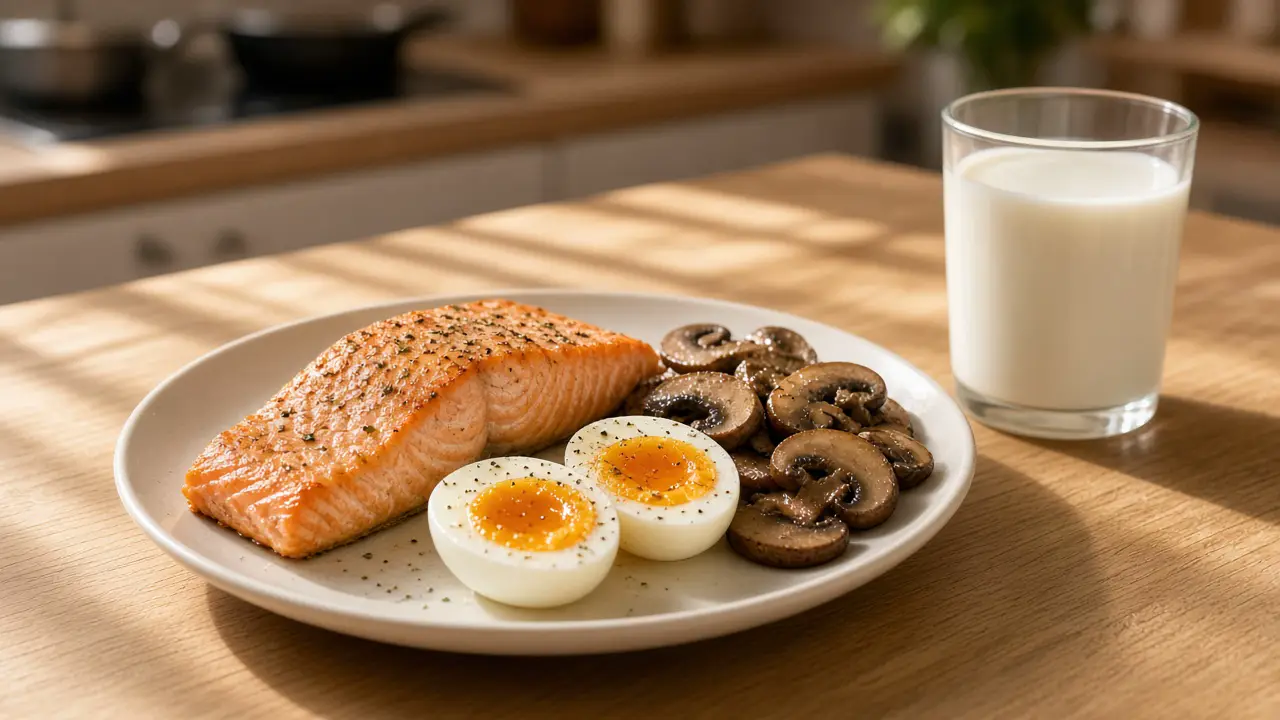
According to NIH ODS, very few foods naturally contain vitamin D. Fatty fish (like trout, salmon, tuna and mackerel) and fish liver oils are among the best natural sources. Beef liver, egg yolks and cheese have small amounts. In the United States, most dietary vitamin D comes from fortified foods: almost all milk there is fortified, as are many plant-based drinks, breakfast cereals and some orange juices, yogurts and margarines. Fortification varies from country to country and product to product — check the label for the actual amount.
Selected examples from Table 3 of the NIH ODS health professional sheet (1 U.S. cup ≈ 240 ml, 3 ounces ≈ 85 g):
| Food | Vitamin D per serving |
|---|---|
| Cod liver oil, 1 tablespoon | 34 mcg (1,360 IU) |
| Rainbow trout, farmed, cooked, 3 oz | 16.2 mcg (645 IU) |
| Sockeye salmon, cooked, 3 oz | 14.2 mcg (570 IU) |
| White mushrooms exposed to UV light, raw, sliced, ½ cup | 9.2 mcg (366 IU) |
| Milk, 2%, vitamin D fortified, 1 cup | 2.9 mcg (120 IU) |
| Soy, almond or oat milk, fortified, 1 cup | 2.5–3.6 mcg (100–144 IU) |
| Sardines (Atlantic), canned in oil, drained, 2 sardines | 1.2 mcg (46 IU) |
| Egg, 1 large, scrambled | 1.1 mcg (44 IU) |
| Light tuna, canned in water, drained, 3 oz | 1.0 mcg (40 IU) |
| Cheddar cheese, 1.5 oz (~42 g) | 0.4 mcg (17 IU) |
| Portabella mushrooms, raw, diced, ½ cup | 0.1 mcg (4 IU) |
| Chicken breast, roasted, 3 oz | 0.1 mcg (4 IU) |
| Broccoli, carrots, almonds, apple, banana, brown rice, whole wheat bread, lentils | 0 |
The microgram and IU figures are the rounded values printed in that NIH table. They are not a prediction for a particular brand.
Three practical takeaways from the table: fatty fish lead by a wide margin; regular mushrooms contribute almost nothing, but mushrooms exposed to UV light (if the package says so) do; and in an egg, the vitamin D is in the yolk. Vegetables, fruit, legumes and grains are excellent sources of other things, but not of vitamin D. For a tender salmon idea, see hot-oil curing for fish, and for eggs, Eggs in the Kitchen.
What about the sun?
According to NIH ODS, your body makes vitamin D when bare skin is exposed to the sun, and most people get at least some vitamin D this way. But clouds, smog, older age and darker skin reduce how much the skin makes. And a point that surprises many people: your skin does not make vitamin D from sunlight through a window, because UVB radiation does not penetrate glass.
On the other hand, ultraviolet radiation from sunshine causes skin cancer. That is why, according to NIH ODS, health experts recommend limiting time in the sun and using sunscreen with SPF 15 or more when you are outside for more than a few minutes. According to the professional sheet, season, time of day, cloud cover, skin color and other factors all affect production, which makes it difficult to give precise guidance on how much sun is "enough." And because the skin limits how much it makes, you cannot get too much vitamin D from sunshine.
Who may get too little
According to NIH ODS, groups more likely to have trouble getting enough:
- Breastfed infants — breast milk alone does not provide enough vitamin D. NIH ODS states that breastfed infants should be given a supplement of 10 mcg (400 IU) a day. Check with your pediatrician about what is right for your baby.
- Older adults — the skin's ability to make vitamin D declines with age.
- People who rarely expose their skin to the sun — because they do not go outside or keep their body and head covered.
- People with dark skin — the darker the skin, the less vitamin D it makes from sunlight.
- Conditions that limit fat absorption — such as Crohn's disease, celiac disease and ulcerative colitis.
- Obesity or gastric bypass surgery — more vitamin D may be needed.
According to the professional sheet, low intakes are also more common in people with milk allergy or lactose intolerance, and in ovo-vegetarians and vegans. Long-term deficiency causes rickets in children and osteomalacia (softening of the bones) in adults. Diagnosis means a blood test and a doctor. According to NIH ODS, the Endocrine Society does not recommend routine testing in healthy people.
What research says — and what it does not
According to NIH ODS, the clearest results concern bone health. In clinical trials, vitamin D and calcium supplements slightly increased bone strength in older adults, but it is not clear whether they reduce falls or fractures. For other conditions the picture is restrained: according to the consumer sheet, in clinical trials vitamin D supplements did not reduce the risk of heart disease, did not prevent or ease depression, did not improve blood sugar levels — and supplements or vitamin D-rich foods do not help with weight loss. In short, vitamin D matters, but it is not a magic fix.
When vitamin D calls for caution
According to NIH ODS, too much vitamin D is harmful. Very high blood levels can cause nausea, vomiting, muscle weakness, confusion, pain, loss of appetite, dehydration, excessive urination and thirst, and kidney stones; in extreme cases, kidney failure, irregular heartbeat and even death. This is almost always caused by excessive amounts from supplements — not from food and not from the sun.
Daily upper limits according to NIH ODS (food, beverages and supplements combined):
| Age | Upper limit per day |
|---|---|
| Birth to 6 months | 25 mcg (1,000 IU) |
| Infants 7–12 months | 38 mcg (1,500 IU) |
| Children 1–3 | 63 mcg (2,500 IU) |
| Children 4–8 | 75 mcg (3,000 IU) |
| Age 9 and older, including pregnancy and breastfeeding | 100 mcg (4,000 IU) |
A doctor might temporarily recommend more than this to treat a deficiency — that is their decision, not ours. Vitamin D supplements may also interact with medicines, according to NIH ODS: orlistat reduces absorption of the vitamin; high doses might make some statins work less well; steroids such as prednisone can lower vitamin D levels; and thiazide diuretics combined with the supplement could raise blood calcium too high. Tell your doctor and pharmacist about every supplement and medicine you take. We do not recommend any supplement, dose or brand.
Meal ideas
General KitchenAppes ideas, not a medical menu:
- Oven-baked salmon or trout once a week, with roasted vegetables and a spoonful of olive oil.
- Shakshuka with mushrooms: whole eggs (yolk included), and if you find mushrooms labeled as UV-exposed, even better.
- Sardine or tuna salad on a slice of whole wheat bread, with tomato and lemon.
- Label check: if you drink milk or a plant-based drink, check whether it is fortified with vitamin D and by how much.
Where KitchenAppes fits in
Keep the fish, egg and mushroom recipes you return to in one place in the KitchenAppes recipe book. And if you have a salmon fillet, eggs and mushrooms at home with no clear plan, Smart Chef can suggest a recipe from what you already have. The app does not calculate vitamin D and does not replace nutrition advice. For safe cooking temperatures for fish and meat, see our food thermometer guide.
Sources
- NIH Office of Dietary Supplements: Vitamin D — Fact Sheet for Consumers (Updated November 8, 2022)
- NIH Office of Dietary Supplements: Vitamin D — Fact Sheet for Health Professionals
KitchenAppes
Download the app