Potassium in the Kitchen: Needs, Food Sources and Cautions
This is general information, not personal medical or nutrition advice. If you have kidney disease, type 1 diabetes, heart failure or liver disease, or you take blood-pressure medicines or diuretics, ask your doctor how much potassium is right for you — including from food and salt substitutes. Do not start or stop a supplement or medicine without your doctor.
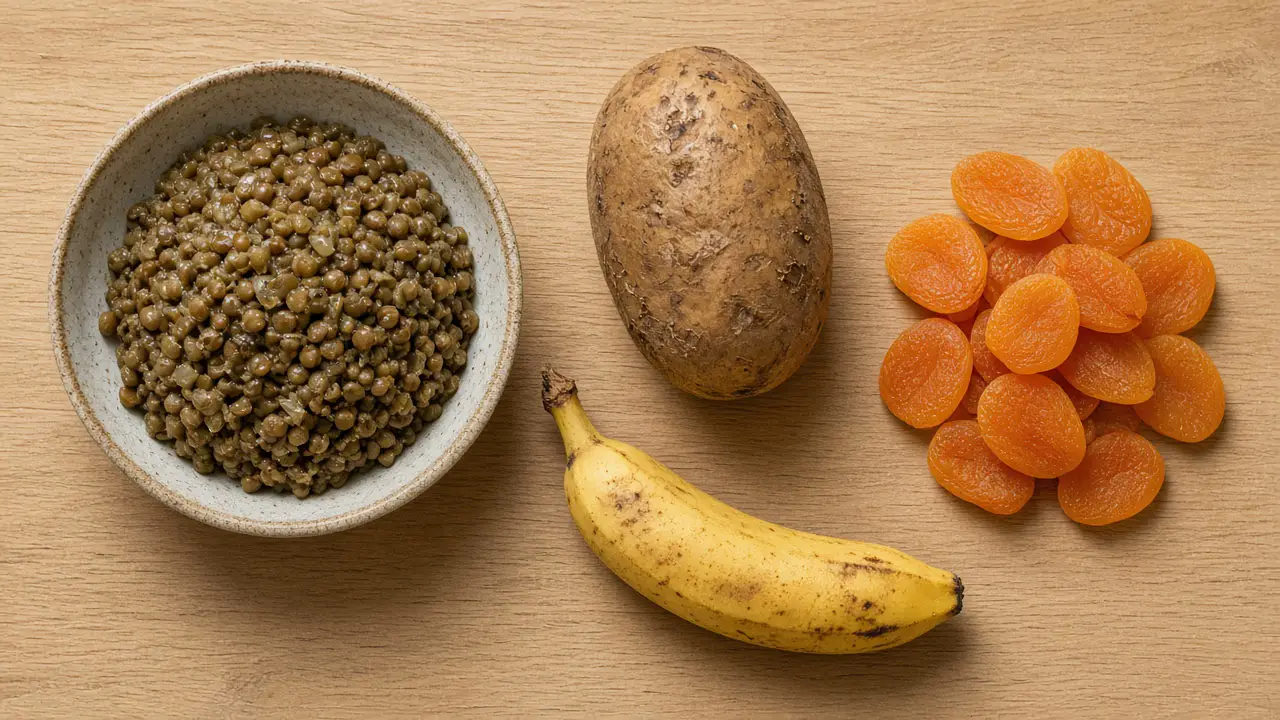
When people think of potassium, most of them think of bananas. But according to the food table of the U.S. National Institutes of Health Office of Dietary Supplements (NIH ODS), a cup of cooked lentils and a baked potato each provide more potassium than a medium banana. In this article we cover what potassium does, how much is recommended by age, which foods supply it, how it connects to salt in the kitchen, and who actually needs to be careful with it — without medical promises.
What potassium does in the body
According to NIH ODS (consumer fact sheet), potassium is a mineral your body needs for almost everything it does: proper kidney and heart function, muscle contraction and nerve transmission. The health professional fact sheet explains that most potassium sits inside cells, and that it has a close relationship with sodium — the main mineral in table salt.
One more point from the professional sheet: the body absorbs about 85%–90% of dietary potassium, and the kidneys adjust excretion to intake. In healthy people with normal kidney function, abnormally low or high blood levels are rare. Here too, a blood test alone does not always reflect the body's stores — so any personal question belongs with a doctor.
How much potassium is recommended per day
Daily amounts according to NIH ODS, in milligrams. These are Adequate Intakes (AIs), updated in 2019 by the U.S. National Academies of Sciences, Engineering, and Medicine, because the data were not sufficient to set a more precise recommendation:
| Age / life stage | Recommended amount per day |
|---|---|
| Infants up to 6 months | 400 mg |
| Infants 7–12 months | 860 mg |
| Children 1–3 | 2,000 mg |
| Children 4–8 | 2,300 mg |
| Boys 9–13 | 2,500 mg |
| Girls 9–13 | 2,300 mg |
| Teen boys 14–18 | 3,000 mg |
| Teen girls 14–18 | 2,300 mg |
| Men 19+ | 3,400 mg |
| Women 19+ | 2,600 mg |
| Pregnant teens | 2,600 mg |
| Pregnant women | 2,900 mg |
| Breastfeeding teens | 2,500 mg |
| Breastfeeding women | 2,800 mg |
Important: according to the professional sheet, these values do not apply to people whose potassium excretion is impaired by a medical condition (such as kidney disease) or by medications.
U.S. food labels show a Daily Value (DV) of 4,700 mg potassium for adults and children age 4 and older. That number is for comparing products on the label, not a personal recommendation — which is why it differs from the table above.
According to NIH ODS, many people in the United States get less than recommended, and even with supplements counted, most people's total intake stays below the recommendation. The simple reason: most supplements contain no more than 99 mg per serving. In other words, the real place for potassium is the plate.
Where to find potassium in the kitchen
According to NIH ODS, potassium is found in a wide range of foods: many fruits and vegetables, legumes (such as lentils and soybeans), potatoes, and also meat, poultry, fish, milk, yogurt and nuts. Among starchy foods, whole-wheat flour and brown rice are much higher in potassium than white flour and white rice.
Selected examples from Table 2 of the NIH ODS professional fact sheet:
| Food | Potassium per serving |
|---|---|
| Dried apricots, ½ cup | 755 mg |
| Lentils, cooked, 1 cup | 731 mg |
| Prunes, ½ cup | 635 mg |
| Raisins, ½ cup | 618 mg |
| Potato, baked, flesh only, 1 medium | 610 mg |
| Kidney beans, canned, 1 cup | 607 mg |
| Orange juice, 1 cup | 496 mg |
| Soybeans, boiled, ½ cup | 443 mg |
| Banana, 1 medium | 422 mg |
| Milk, 1%, 1 cup | 366 mg |
| Spinach, raw, 2 cups | 334 mg |
| Chicken breast, grilled, 3 ounces | 332 mg |
| Salmon, cooked, 3 ounces | 326 mg |
| Tomato, raw, 1 medium | 292 mg |
| Broccoli, cooked, chopped, ½ cup | 229 mg |
| Brown rice, cooked, 1 cup | 154 mg |
| Whole-wheat bread, 1 slice | 81 mg |
| White rice, cooked, 1 cup | 54 mg |
| White bread, 1 slice | 37 mg |
Two practical takeaways from the table: bananas are a good source, but not the "champion" — lentils, potatoes and beans beat them. And switching from white rice to brown rice, or from white bread to whole-wheat bread, adds potassium without changing the whole meal. More in legumes in the home kitchen, whole grains and fruits and vegetables.
Potassium and salt: why they appear together
According to NIH ODS, low potassium intake is linked to a higher risk of high blood pressure, especially when the diet is high in salt (sodium). The U.S. Food and Drug Administration (FDA) has approved the health claim that "Diets containing foods that are a good source of potassium and that are low in sodium may reduce the risk of high blood pressure and stroke."
Note the careful wording: it is about a whole eating pattern, not one food and not a supplement. According to NIH ODS, the DASH eating pattern, which emphasizes fruits, vegetables and low-fat dairy, lowered blood pressure in trials — but it also adds magnesium and calcium, so the effect cannot be attributed to potassium alone. The researchers note that more research is needed before firm conclusions. We wrote about cutting salt in everyday cooking in salt in cooking, and about magnesium in magnesium in the kitchen.
Salt substitutes: not for everyone
Many salt substitutes replace some or all of the sodium chloride with potassium chloride. According to NIH ODS, their potassium content varies widely — from about 440 to 2,800 mg per teaspoon. People with kidney disease, or who take certain medications, should talk to a doctor before switching to a salt substitute, because of the risk of too-high blood potassium.
When potassium calls for caution
According to NIH ODS, potassium from food and beverages has not been shown to harm healthy people with normal kidney function, because the excess leaves in the urine. That is also why no upper limit has been set.
But in some situations the picture flips:
- Chronic kidney disease — the kidneys cannot remove the excess, and blood potassium can rise even from typical amounts in food.
- Certain medicines — according to NIH ODS, for example ACE inhibitors, angiotensin receptor blockers and potassium-sparing diuretics reduce potassium excretion. Other diuretics (loop and thiazide) work the other way and can lower potassium.
- Other conditions in which high levels can develop: type 1 diabetes, congestive heart failure, liver disease and adrenal insufficiency.
- Large amounts of supplements or salt substitutes — according to NIH ODS, these can cause excess even in healthy people if the amount exceeds what the kidneys can remove.
If you belong to one of these groups, ask your doctor or dietitian how much potassium is right for you from all sources. Tell your doctor and pharmacist about every supplement and medicine. We do not recommend any supplement, dose or brand.
Who may get too little
According to NIH ODS, severe deficiency (hypokalemia) is rare in healthy people and is rarely caused by diet alone. It is more often linked to prolonged diarrhea or vomiting, use of laxatives or certain diuretics, heavy sweating or dialysis. Groups at higher risk of inadequate intake include people with inflammatory bowel disease (such as Crohn's disease and ulcerative colitis) and people using certain medicines. Possible mild symptoms: constipation, tiredness and muscle weakness. Diagnosis and treatment — only with a doctor.
Meal ideas
General KitchenAppes ideas, not a medical menu, and not for anyone told to limit potassium:
- Lentil and tomato soup: a cup of cooked lentils in a tomato base, with herbs instead of a lot of salt.
- Stuffed baked potato: with beans, yogurt and green onion.
- Breakfast bowl: yogurt with sliced banana and a few chopped dried apricots.
- A small swap: brown rice instead of white in a dish you make every week.
Where KitchenAppes fits
Keep your lentil soups, bean stews and baked potatoes in one place in the KitchenAppes recipe book. If you have lentils, tomatoes and potatoes at home with no clear plan, Smart Chef can suggest a recipe from what you already have. The app does not calculate potassium and does not replace nutrition advice.
Sources
- NIH Office of Dietary Supplements: Potassium — Fact Sheet for Consumers (Updated March 22, 2021)
- NIH Office of Dietary Supplements: Potassium — Fact Sheet for Health Professionals (Updated June 2, 2022)
KitchenAppes
Download the app