Iron in Your Daily Menu: How Much You Need and Best Sources
This is general information, not medical or personal nutrition advice. Iron needs vary by age, sex, pregnancy and health, and too much iron from supplements can be harmful. If you suspect a deficiency, or before making a significant change to your diet or taking a supplement, consult a doctor or a registered dietitian.
Iron is one of the most talked-about minerals, and yet it isn't always clear where it comes from, or why two meals with the same amount of iron on paper aren't necessarily equal. According to the U.S. National Institutes of Health Office of Dietary Supplements (NIH ODS), food contains two kinds of iron, and the body absorbs them differently. Even what you drink with a meal can make a difference. This article covers what iron does, how much is recommended, which foods provide it, what helps and hinders absorption, and how it all looks in an ordinary weekly menu.
What iron does in the body
According to NIH ODS, the body uses iron to make hemoglobin, a protein in red blood cells that carries oxygen from the lungs to every part of the body, and myoglobin, a protein that supplies oxygen to muscles. Iron is also needed for growth and development and to make some hormones. According to NIH ODS, most of the 3 to 4 grams of iron in an adult body is found in hemoglobin, and much of the rest is stored in the liver, spleen and bone marrow.
According to NIH ODS, most people in the U.S. get enough iron from their diet. Still, some groups are more likely to have trouble getting enough, including teen girls and women with heavy periods, pregnant women, infants (especially premature babies), frequent blood donors and people with certain digestive conditions. If you belong to one of these groups, or feel ongoing tiredness and weakness, check with a doctor rather than guessing on your own.
How much iron is recommended per day
Recommended daily amounts according to NIH ODS, in milligrams:
| Age | Recommended per day |
|---|---|
| Infants up to 6 months | 0.27 mg |
| Infants 7–12 months | 11 mg |
| Children 1–3 | 7 mg |
| Children 4–8 | 10 mg |
| Children 9–13 | 8 mg |
| Teen boys 14–18 | 11 mg |
| Teen girls 14–18 | 15 mg |
| Men 19–50 | 8 mg |
| Women 19–50 | 18 mg |
| Adults 51+ | 8 mg |
| Pregnancy (teens and women) | 27 mg |
| Breastfeeding, teens 14–18 | 10 mg |
| Breastfeeding, women 19+ | 9 mg |
Why do women aged 19–50 need more than twice as much as men the same age? According to the nutrition website of the Harvard T.H. Chan School of Public Health, the reason is blood loss through menstruation, and in pregnancy, the needs of the growing fetus. From age 51 the recommendation for women drops to 8 mg, on the assumption that menstruation has stopped. Harvard notes that for some women this happens later.
According to NIH ODS, vegetarians who don't eat meat, poultry or seafood need almost twice the amounts in the table (the professional version of the fact sheet puts it at 1.8 times), because the body doesn't absorb iron from plants as well.
There's an upper limit too. According to NIH ODS, the maximum daily amount from all sources combined (food, beverages and supplements) is 40 mg up to age 13 and 45 mg from age 14. A doctor may prescribe more for a limited time to treat a deficiency, but that's a medical decision.
Two kinds of iron, and where to find them
According to NIH ODS and Harvard, iron in food comes in two forms:
- Heme iron: found only in meat, poultry and seafood. The body absorbs it better.
- Non-heme iron: found in plant foods and fortified foods, and also in meat, poultry and seafood alongside heme iron.
According to NIH ODS, heme iron makes up only about 10% to 15% of total iron intake in Western populations. The bioavailability of iron (how much of it the body actually uses) is about 14% to 18% from mixed diets that include meat, seafood and vitamin C, and about 5% to 12% from vegetarian diets.
A few examples of iron per serving, from the NIH ODS table (original servings are in cups and ounces; we converted ounces to grams):
| Food | Iron per serving |
|---|---|
| Breakfast cereal fortified with 100% of the DV, 1 serving | 18 mg |
| White beans, canned, 1 cup | 8 mg |
| Beef liver, pan fried, 85 g | 5 mg |
| Lentils, boiled, ½ cup | 3 mg |
| Spinach, boiled, ½ cup | 3 mg |
| Tofu, firm, ½ cup | 3 mg |
| Chickpeas, boiled, ½ cup | 2 mg |
| Tomatoes, canned, stewed, ½ cup | 2 mg |
| Beef, braised, 85 g | 2 mg |
| Sardines canned in oil, with bone, 85 g | 2 mg |
| Potato, baked, with skin, 1 medium | 2 mg |
| Cashews, roasted, 28 g | 2 mg |
| Chicken, roasted, 85 g | 1 mg |
| Egg, hard boiled, 1 large | 1 mg |
| Broccoli, boiled, ½ cup | 1 mg |
| Raisins, ¼ cup | 1 mg |
| Whole wheat bread, 1 slice | 1 mg |
| Milk, 1 cup | 0 mg |
According to NIH ODS, the Daily Value (DV) for iron used on U.S. labels is 18 mg, and in the U.S. about half of dietary iron comes from bread, cereal and other grain products, partly because wheat flour there is fortified with iron. Wherever you live, the label tells you whether a product is fortified.
What helps absorption and what gets in the way
These effects mainly apply to non-heme iron, the kind from plants.
What helps:
- Vitamin C in the same meal. According to NIH ODS, citrus fruits, strawberries, sweet peppers, tomatoes and broccoli improve absorption of iron from plant foods.
- A little meat, poultry or fish in the same meal. According to MedlinePlus (the U.S. National Library of Medicine), mixing some lean meat, fish or poultry with beans or dark leafy greens can improve absorption from the plant sources up to three times.
- A cast-iron skillet. According to MedlinePlus, cooking in a cast-iron skillet can also increase the amount of iron in food.
What gets in the way:
- Tea and coffee. According to MedlinePlus, substances in black tea bind to dietary iron so the body can't use it. According to the UK's NHS, large amounts of tea, coffee, milk and dairy foods make it harder for the body to absorb iron.
- Calcium. According to NIH ODS, calcium might reduce the absorption of both kinds of iron, although this effect hasn't been definitively established. Harvard specifically mentions large amounts of calcium from supplements.
- Phytates and polyphenols. According to NIH ODS and Harvard, phytates (in grains and beans), bran fiber and some polyphenols in plant foods reduce absorption of non-heme iron. That's also why spinach, for example, contains iron but has low iron bioavailability.
It's worth keeping this in proportion: according to NIH ODS, in a typical Western diet the effects of these enhancers and inhibitors are toned down, and they have little effect on most people's iron status. So there's no need to give up coffee or legumes. You can simply add a vitamin C–rich vegetable to the plate and, if it matters to you, avoid large amounts of tea or coffee around meals.
A vegetarian or vegan menu
According to Harvard, it's possible to get enough iron on a vegetarian or vegan diet with careful planning. Because plant iron is less well absorbed, you need more of it, or you need to pay attention to how you eat it: with vitamin C–rich foods, and not in the same meal as calcium-rich foods, calcium supplements or tea.
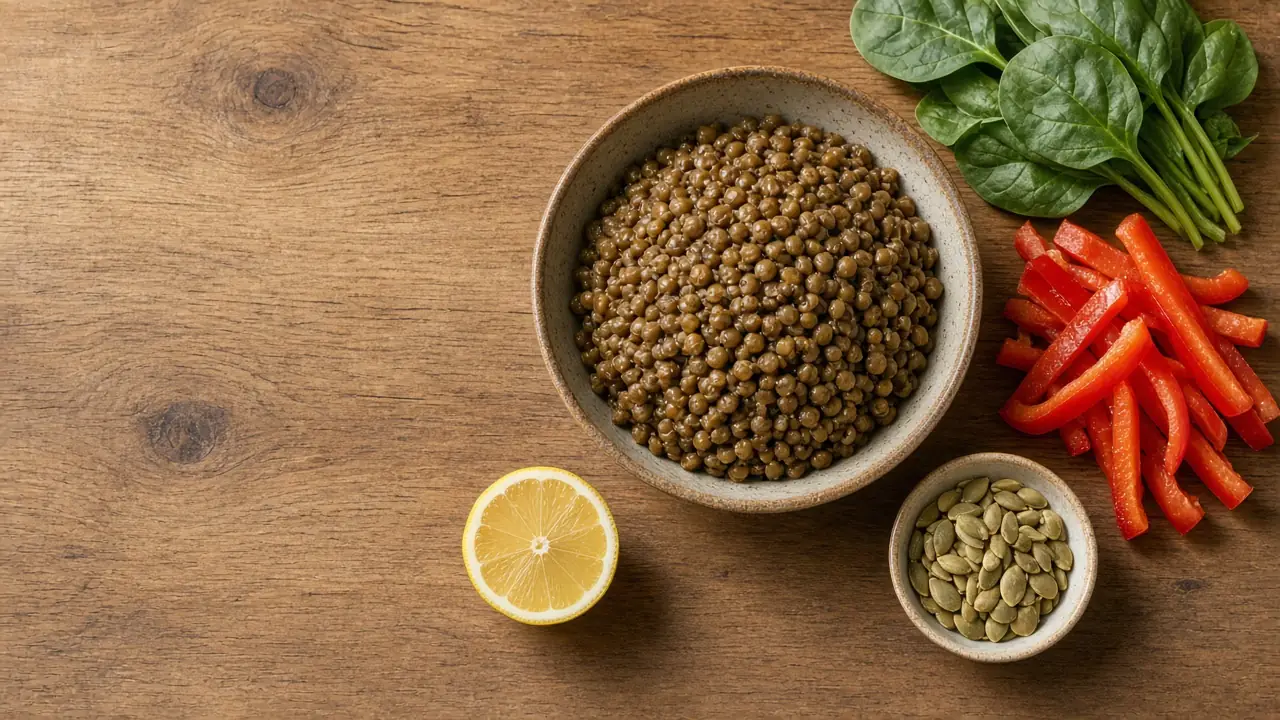
Good plant sources according to NIH ODS and Harvard: beans and lentils, tofu, spinach, peas, nuts and seeds, dried fruit such as raisins, potatoes with the skin, and fortified breakfast cereals and breads. Harvard even suggests a salad that combines plant iron with vitamin C: cooked beans or lentils, diced fresh tomatoes, raw baby spinach, pumpkin seeds or cashews, and raisins or chopped dried apricots, with a dressing of 2 tablespoons lemon juice, ½ teaspoon Dijon mustard, 3 tablespoons olive oil and 1 teaspoon honey (optional). Stir well and let it sit for at least 15 minutes so the flavors come together.
For more on legumes and how to work them into everyday cooking, see our guide to legumes in the home kitchen.
What about iron supplements?
Briefly, and without a recommendation: we don't recommend any supplement, dose or type. According to NIH ODS, there are iron-only supplements and multivitamins with iron, and at high doses they can cause nausea, constipation and stomach pain. Iron supplements can affect how some medicines are absorbed, and according to NIH ODS, calcium and iron supplements are best taken at different times of day. There's also an inherited condition, hemochromatosis, in which iron builds up in the body, and people with it should avoid iron supplements.
And one thing that matters in every home: according to NIH ODS, accidental overdose of iron-containing products is a leading cause of fatal poisoning in children under 6. Keep supplements out of children's reach.
Whether you need a supplement at all, which one and how much, is something to settle only with a doctor, after testing.
Meal ideas
A few simple ways to pair iron sources with vitamin C through the week (our general ideas, not a personalized menu):
- Breakfast: fortified breakfast cereal (check the label) with strawberries, or an egg with a tomato and red pepper salad.
- Lunch: Harvard's salad above, or lentil soup with tomatoes and parsley and half a lemon squeezed in just before serving.
- Dinner: a chickpea and spinach stew in tomato sauce, beef patties with broccoli, or chicken breast with a baked potato in its skin and a pepper salad.
- Snack: cashews or pumpkin seeds with a few raisins.
- Drinks: water with the meal; tea or coffee can wait for another time.
More ideas for eating a range of colors, including vitamin C–rich fruit and vegetables, in our article on vegetables and fruit every day. And if you build your meals around protein, we also have a guide to protein in the everyday kitchen.
Where KitchenAppes fits in
In KitchenAppes you can keep the recipes you make again and again, like lentil soup, chickpea and spinach stew or a bean salad, in one place and find them when you plan the week. And if you have lentils, tomatoes and a pepper at home with no clear plan, Smart Chef can suggest a recipe from the ingredients you already have.
Sources
- NIH Office of Dietary Supplements: Iron — Fact Sheet for Consumers
- NIH Office of Dietary Supplements: Iron — Fact Sheet for Health Professionals
- Harvard T.H. Chan School of Public Health, The Nutrition Source: Iron
- MedlinePlus (U.S. National Library of Medicine): Iron in diet
- NHS: Iron deficiency anaemia
KitchenAppes
Download the app