Slow Cooker Safety: How to Cook Safely and What to Keep Out
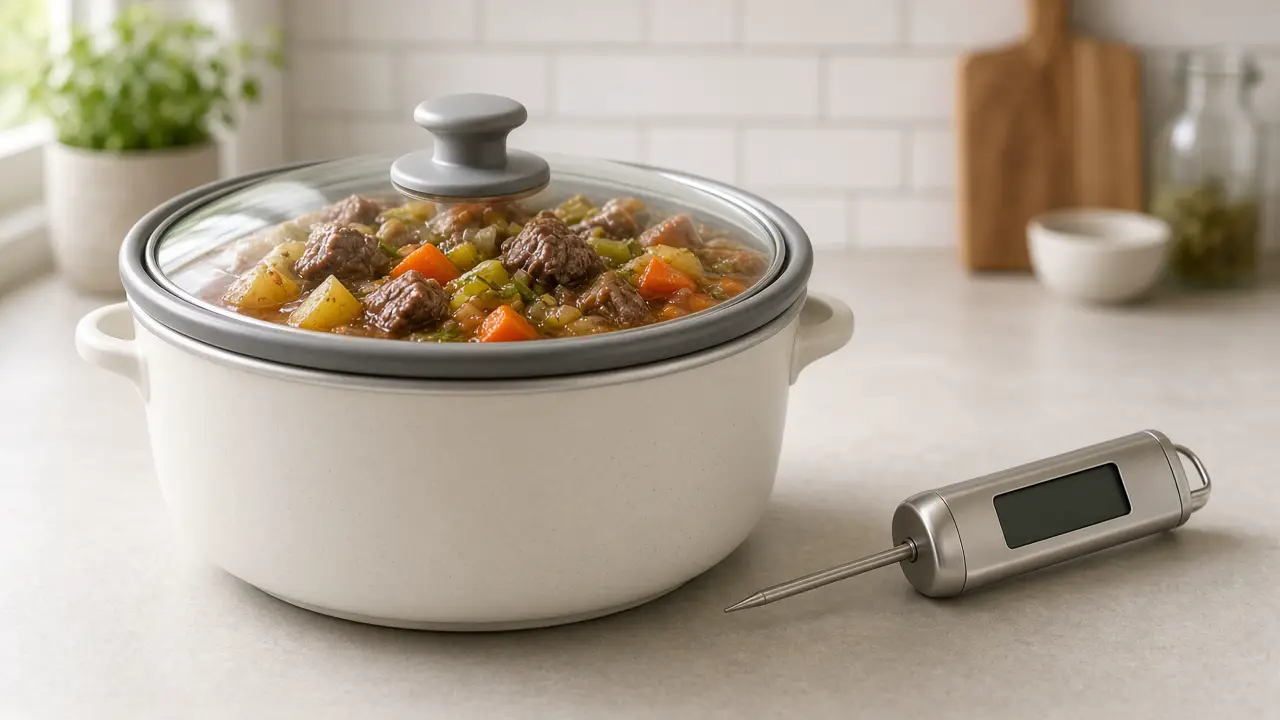
A slow cooker is one of the most convenient appliances in the kitchen: load it in the morning, come home to a finished stew. But precisely because it cooks slowly at low heat, a few rules are worth knowing — what to thaw first, how full to fill it, why not to lift the lid, and what to do with dry red kidney beans. This guide is based on the USDA Food Safety and Inspection Service (FSIS) and on the extension services of Colorado State, Utah State and Montana State universities.
How a slow cooker works, and why it is safe
According to USDA FSIS, a slow cooker is a countertop electrical appliance that cooks foods slowly at a low temperature — generally between 170°F and 280°F (about 77°C–138°C). The direct heat from the pot, the lengthy cooking and the steam created inside the tightly covered container combine to destroy bacteria, which makes it a safe way to cook. The low heat also helps less expensive, leaner cuts of meat become tender and shrink less. And one more advantage: per FSIS, a slow cooker uses less electricity than an oven.
It is not a pressure cooker. Pressure cookers and multicookers work differently — we covered them in our Instant Pot Duo guide and in which appliance for dinner.
Before you switch it on
- Clean start: begin with a clean cooker, clean utensils and a clean work area, and wash your hands with warm soapy water for at least 20 seconds before and during prep (Colorado State).
- Fridge until the last moment: per FSIS, keep perishable foods refrigerated until preparation time. If you cut meat and vegetables in advance, store them separately in the fridge. The cooker may take several hours to reach a bacteria-killing temperature, and constant refrigeration keeps bacteria from getting a "head start." Montana State adds: never let food sit more than two hours before turning the cooker on.
- Placement: a dry, stable surface with at least 2 inches (about 5 cm) of space around the cooker, plugged directly into an outlet — no extension cord (Colorado State).
Always thaw first
Per FSIS, always thaw meat or poultry before putting it into a slow cooker. Colorado State explains why: frozen pieces might not reach 140°F (60°C) quickly enough, which can result in foodborne illness. If needed, meat can be thawed quickly in a microwave before it goes into the cooker. Safe thawing methods are in safe thawing.
How full, and in what order
- Between half and two-thirds: per Colorado State, fill the cooker no less than half full and no more than two-thirds full, for safe and even heat distribution.
- Vegetables at the bottom: per FSIS, vegetables cook slower than meat and poultry in a slow cooker, so put them in first. Montana State specifically mentions dense vegetables such as carrots and potatoes.
- Liquid: when cooking meat or poultry, the water or stock should almost cover the ingredients to create steam and transfer heat (Colorado State). FSIS suggests high-moisture foods — chili, soup, stew or spaghetti sauce.
- Pasta and dairy at the end: per Montana State, add pasta at the end of cooking (or cook it separately), and milk, cheese and cream about an hour before serving.
High, low, and the lid
Per FSIS, if possible turn the cooker to the highest setting for the first hour, then to low or the setting your recipe calls for. Still, it is safe to cook on low the entire time — for example when you leave for work. While the food is cooking and once it is done, it stays safe as long as the cooker is operating.
The lid is part of safety: per Colorado State, each time it is raised the internal temperature drops 10–15°F (about 6–8°C), and it takes roughly 20 minutes to recover the lost heat. So lift it only to stir or check doneness. If in doubt — especially with meat — use a food thermometer to confirm the food reached 165°F (74°C).
Dry red kidney beans: not straight into the pot
According to Utah State University Extension, dry beans contain a protein called phytohaemagglutinin (PHA), which can cause nausea, vomiting, cramping and diarrhea. Among beans commonly available in the U.S., the highest levels are in dark red kidney beans and black beans. PHA is very heat stable, and acid (such as tomatoes) increases that stability.
A slow cooker may not reach a high enough temperature to completely cook dry beans. So, per Utah State:
- Boil the dry beans on the stovetop for 10 minutes — this destroys PHA.
- Drain and rinse.
- Only then add them to the cooker with the other ingredients.
Canned beans are processed at high temperature and pressure, so per Utah State they can go straight into the slow cooker. More on soaking and cooking legumes in legumes in the home kitchen.
Power outages
Per FSIS:
- You were not home during the outage — throw the food away, even if it looks done.
- You are home — finish cooking immediately another way: a gas stove, an outdoor grill, or a house where the power is on.
- The food was completely cooked before the power went out and you are home — it should stay safe up to two hours in the cooker with the power off.
Leftovers: do not reheat in the slow cooker
Per FSIS and Colorado State:
- Remove leftovers from the cooker, divide them into shallow covered containers, and refrigerate within two hours after cooking is finished.
- Do not reheat leftovers in a slow cooker. Reheat on the stove, in a microwave or in an oven until they reach 165°F (74°C).
- After reheating, you can move the food to a preheated slow cooker to keep it hot for serving — at least 140°F (60°C), measured with a thermometer.
More on storing and reheating in leftovers in the fridge.
How to adapt a regular recipe to a slow cooker
According to Montana State, most recipes can be adapted. A few rules:
- Less liquid: about half the liquid in the original recipe, because liquids do not boil away as in conventional cooking (soups are the exception). You can always add more later.
- One hour on high ≈ two hours on low, generally.
- Most uncooked meat-and-vegetable combinations need at least 8 hours on low or 4 hours on high.
Montana State's time chart:
| Original recipe time | On low | On high |
|---|---|---|
| 15–30 minutes | 4–6 hours | 1½–2 hours |
| 35–45 minutes | 6–10 hours | 3–4 hours |
| 50 minutes to 3 hours | 8–16 hours | 4–6 hours |
And in every case, per Colorado State and Montana State — read and follow the manufacturer's instructions for your specific cooker.
Have an older cooker? A simple test
Colorado State suggests a test to see whether an older cooker still reaches safe temperatures:
- Fill the cooker half to two-thirds full with tap water.
- Heat on low for 8 hours with the lid on.
- Check the water temperature quickly with an accurate thermometer (lifting the lid drops the heat).
- The water should be 185°F–200°F (about 85°C–93°C). Below 185°F (85°C), the cooker does not heat food adequately to avoid food safety problems and should be replaced.
Where KitchenAppes fits
Save your go-to slow cooker recipes in the KitchenAppes recipe book, and note the setting, the time, and whether the beans were boiled first. While cooking, the app's cook mode shows one step per screen, with timers. And if you have chicken, potatoes and carrots at home with no plan, Smart Chef can suggest a stew from what you already have — the safety rules above are still yours to check.
Sources
- USDA Food Safety and Inspection Service: Slow Cookers and Food Safety (Last Updated Aug 08, 2013)
- Colorado State University Extension: Crockpot and Slow Cooker Food Safety (Reviewed October 2025)
- Utah State University Extension: Killer Kidney Beans
- Montana State University Extension: Cooking With a Slow Cooker
KitchenAppes
Download the app