Fridge Organization for Food Safety: Where Raw Meat Goes
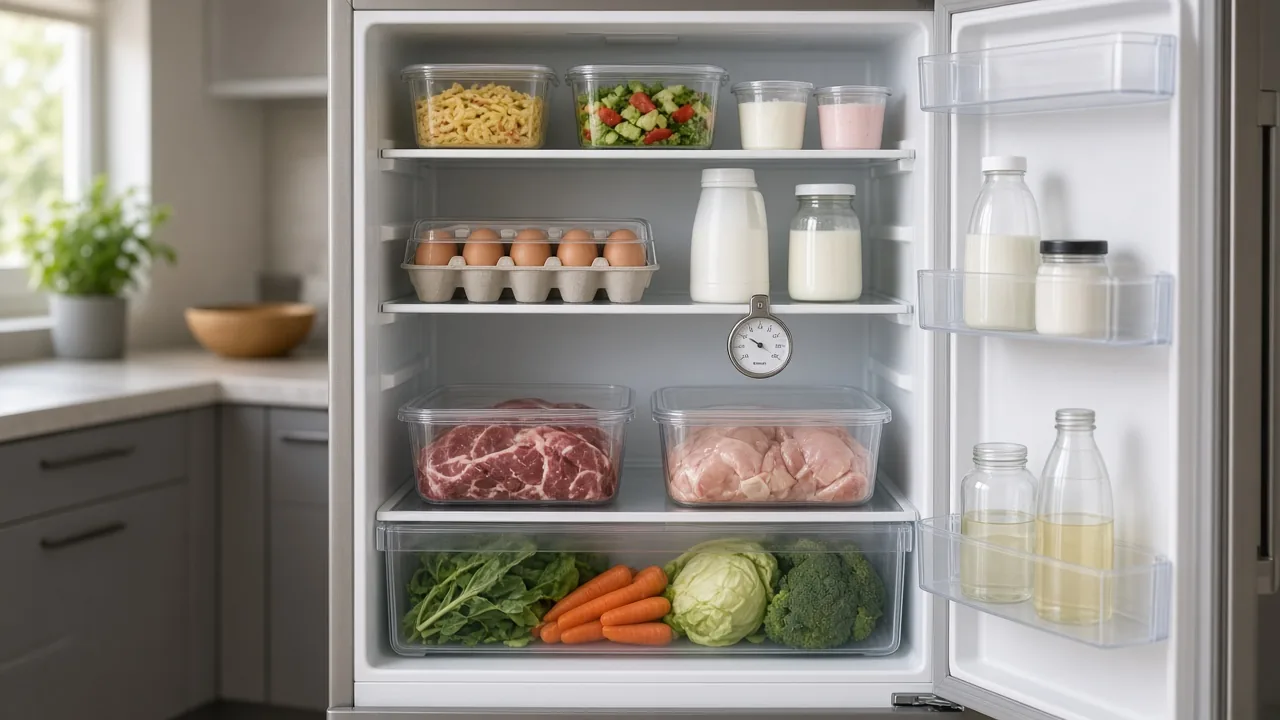
A fridge looks like a tall cupboard with shelves, but what sits where matters more than convenience: juices from raw meat dripping onto a ready salad, eggs on the warmer door, leftovers forgotten for a week — these are exactly the scenarios the FDA warns about. This guide explains why organization matters, which temperatures to hold, where to put things in a home kitchen, and how to handle leftovers and power outages — without replacing the more detailed leftovers and freezing articles.
Why fridge organization matters
According to the FDA, the point of storing food correctly is to slow or stop the growth of bacteria such as Salmonella and E. coli, and to keep ready-to-eat food safe from cross-contamination. Drips from raw meat, poultry or fish juices onto washed produce or cooked leftovers move bacteria without you noticing. In addition, according to the FDA, Listeria can grow in the refrigerator on ready-to-eat foods — especially if the temperature is above 4°C (40°F).
More on cross-contamination in the kitchen overall in our guide to cross-contamination in the kitchen.
Temperatures: fridge, freezer and a thermometer
According to the FDA ("Are You Storing Food Safely?" and "Safe Food Handling"):
- Fridge: at or below 40°F, that is 4°C or below.
- Freezer: 0°F, that is -18°C.
- Check with an appliance thermometer — the reliable way to know the real temperature, not only the dial on the appliance.
- Don't pack so tight that air can't circulate. The FDA notes not to crowd the refrigerator or freezer so tightly that air can't move.
- According to the FDA, food that needs refrigeration — meat, poultry, seafood, eggs, produce that requires chilling, leftovers and take-out — should not sit at room temperature for more than two hours. If the air is above 90°F (about 32°C), that window shortens to one hour. The same rule applies to restaurant "doggie bags" and ready-to-eat food.
A shelf map for a home kitchen
Commercial kitchens use a detailed shelf hierarchy based on required cooking temperatures. At home you can follow a simpler principle based on FDA Separate tips and safe-storage guidance: ready-to-eat food up high, raw meat down low in sealed containers, and eggs inside the fridge, not on the door.
A practical home adaptation:
| Zone | What goes there | Why |
|---|---|---|
| Top | Ready-to-eat food, covered leftovers, washed produce, yogurt | Farthest from drips of raw juices |
| Middle (inside, not the door) | Dairy; eggs in their carton inside the fridge | According to the FDA the door is warmer; the FDA Separate tip says lower shelves, in the original carton. Here: an interior shelf above raw meat, as a home adaptation |
| Lower | Raw fish and whole cuts of beef and similar, in sealed containers or well wrapped | Juices can't drip onto other food below |
| Bottom | Raw poultry in sealed containers | Poultry needs the highest safe internal cook temperature (165°F / 74°C) — so in a "higher cook temp lower on the shelf" logic it sits at the bottom |
According to the FDA Separate tip: place raw meats in sealed containers or plastic wrap on the lower shelves of the fridge or freezer. According to "Are You Storing Food Safely?": store eggs in their carton inside the refrigerator rather than on the door.
To be clear: this is a home adaptation, not a copy of a commercial food code. Professional kitchens sometimes use a more detailed hierarchy (for example by minimum cook temperature for each food type). At home the principle is enough: ready-to-eat up high, raw down low in containers that don't drip, and keep temperature-sensitive food off the door.
A few everyday habits that help:
- When you unpack groceries, put raw items on the bottom in sealed containers or separate bags first, then yogurt and salad greens up top.
- Ground meat and poultry bought in store trays — better to move them into a sealed container or a double bag before they sit in the fridge, to prevent drips.
- Washed salad vegetables don't go under raw meat, even if "there's nowhere else."
Covered containers, cleaning and Listeria
According to the FDA:
- Keep refrigerated foods in covered containers or sealed bags.
- Clean the refrigerator regularly and wipe spills immediately — this helps reduce Listeria growth and stops drips from thawing meat from spreading bacteria from one food to another.
- Check leftovers daily and throw out anything that looks or smells suspicious. Important: food can make you sick even when it doesn't look spoiled.
- Marinate food only in the refrigerator. At room temperature bacteria multiply quickly in marinade.
- Don't reuse marinade that touched raw food as a sauce unless you bring it to a rapid boil first.
Ready-to-eat foods such as luncheon meats — according to the FDA, use them as soon as possible. The longer they sit in the fridge, the more chance Listeria has to grow, especially if the temperature is above 4°C.
More on eggs in the home kitchen in our guide to eggs in the kitchen.
Leftovers: shallow containers and links
According to the FDA, divide large amounts of leftovers into shallow containers so they cool quickly in the fridge. Full detail on the two-hour rule, how many days in the fridge, reheating to 74°C and thawing — in our guide to leftovers in the fridge. On thawing meat and poultry safely — safe thawing. On what freezes well and how to pack — freezing food at home.
Power outage (briefly)
According to the FDA:
- If you keep the door closed, a refrigerator will keep food cold for about four hours.
- A full freezer holds an adequate temperature for about 48 hours if the door stays shut.
- After power returns: discard refrigerated perishables (meat, poultry, fish, milk, eggs, leftovers) that have been above 4°C for four hours or more.
For more on refreezing after an outage, see our home freezing guide. If you don't have a fridge thermometer, after a long outage it's wiser to be cautious: when in doubt, throw it out. A container of leftovers isn't worth a bout of foodborne illness.
Where KitchenAppes fits in
On a KitchenAppes shopping list you can note what is missing after you reorganize the fridge. You can keep the recipes that match leftovers you often have in one place. And if the fridge holds vegetables, half a pack of cheese and leftover chicken with no clear plan, Smart Chef can suggest a recipe from the ingredients you already have.
Sources
- U.S. Food and Drug Administration: Are You Storing Food Safely?
- U.S. Food and Drug Administration: Safe Food Handling
- U.S. Food and Drug Administration: Separate — Food Safety Quick Tips (July 2018)
KitchenAppes
Download the app