Kitchen Knives: The Three You Need — Sharpening and Storage
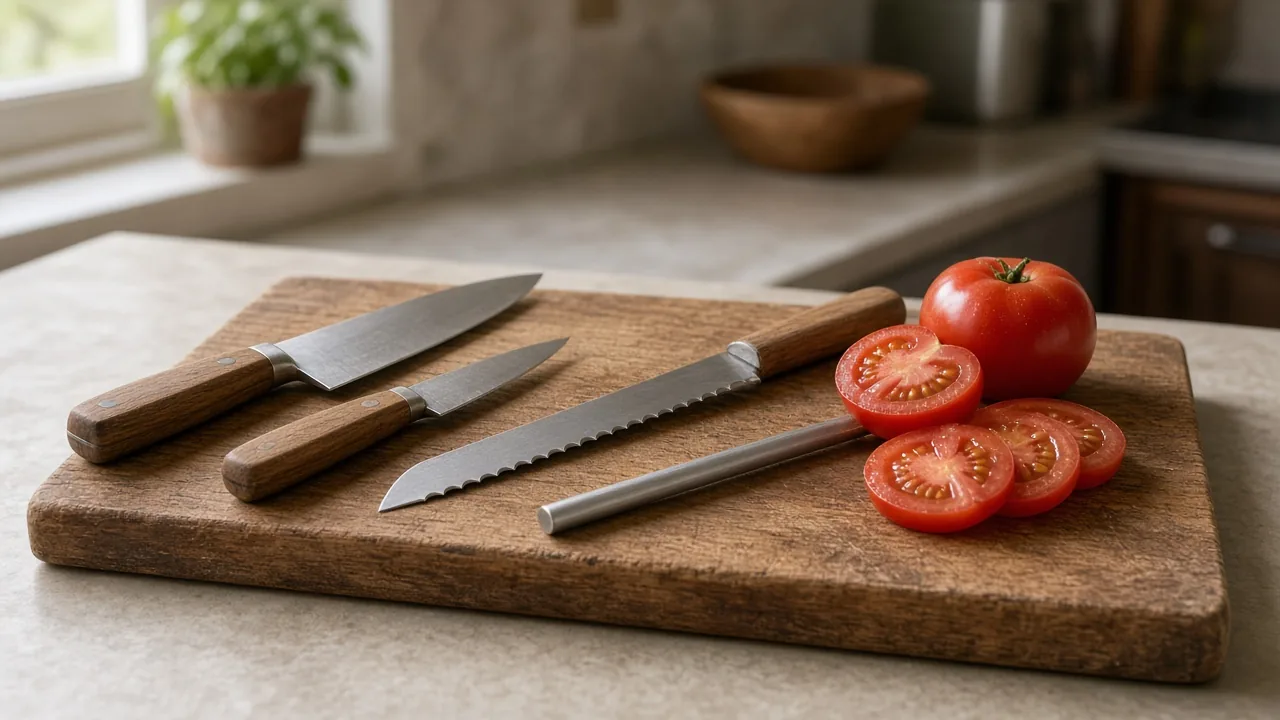
A big set of knives in a wooden block looks impressive on the counter, but according to test kitchens and cooking guides, almost all home prep work gets done with just three knives. A good, sharp knife makes prep faster and safer — and it is the dull knife that slips. In this article we look at the three knives that cooking guides and test kitchens agree on, the difference between honing and sharpening, washing and storage, the cutting board, and safe cutting habits. We covered cleaning boards and keeping raw meat apart from vegetables separately in Cross-contamination in the kitchen: boards, plates and marinade, so here we focus on the knife itself.
The three knives you really need
According to America's Test Kitchen, most cooks need only three knives, and they cover almost all the food prep you are likely to do. A guide from Mississippi State University Extension (HappyHealthy) also recommends starting with the same three, and points out that you don't need to buy a block set — you can buy each knife individually.
| Knife | Typical blade length | What it's for |
|---|---|---|
| Chef's knife | about 20–25 cm (8–10 inches) | Almost any job on the board: chopping vegetables, slicing meat, mincing herbs, breaking down a chicken |
| Paring knife (small knife) | about 8–10 cm (3–4 inches) | Small, precise jobs: peeling, coring an apple, cutting limes into wedges, checking whether a potato is cooked |
| Serrated knife (bread knife) | about 20–25 cm (8–10 inches) | Bread of every kind, tomatoes, layer cakes, and tough-skinned fruit such as watermelon and pineapple |
A few notes from the sources:
- The chef's knife is the one to buy first. According to Mississippi State, if you can only buy one knife, buy a chef's knife. America's Test Kitchen prefers a gently curved blade of about 8 inches (20 cm) and a large, grippy handle.
- A Japanese chef's knife (gyuto) is a possible alternative, but according to America's Test Kitchen it is less versatile: its hard steel is more likely to chip and get damaged when breaking down chickens or cutting dense foods such as butternut squash.
- A good paring knife is short and thin, with a blade under 4 inches (10 cm), according to America's Test Kitchen.
- A serrated knife is worth having even if you only cut bread occasionally, because according to America's Test Kitchen it also suits very delicate foods such as tomatoes and layer cakes.
- Hold it before you buy. Mississippi State recommends holding a few knives before buying, because handles have different shapes and some simply feel more comfortable.
Honing versus sharpening: two different things
The most common confusion is between honing and sharpening.
- Honing is done on a honing rod (a "steel"). According to Victorinox and Shun, with use the fine edge of the blade bends slightly out of line, and the knife feels dull even though the edge is still there. Honing brings it back into line. According to Shun, honing does not remove metal; according to Victorinox, it doesn't remove metal, or removes only a little.
- Sharpening removes a small amount of metal to create a new edge. It is done with a sharpening stone, a manual or electric sharpener, or an abrasive diamond or ceramic rod.
How often? According to Victorinox, hone regularly — ideally before or after each cooking session, or every few uses. Sharpening is needed far less often: for most home cooks, once or twice a year by a professional is enough, with regular honing in between. According to Shun, for many home cooks sharpening about once a year is often enough. Every sharpening removes metal, so sharpening too often gradually thins the blade.
How do you know it needs sharpening? Victorinox suggests two tests: slice a sheet of paper — if it tears or snags, the knife is dull; or slice a tomato — a sharp knife glides through with no resistance. If the knife still struggles after honing, it is time to sharpen.
How to hone at home
According to Victorinox's instructions:
- If you're not experienced, rest the tip of the rod on a folded tea towel or a damp dish cloth so it doesn't slip.
- Hold the knife at about a 20° angle to the rod.
- Pull the blade down and towards you, from the heel (near the handle) to the tip.
- Repeat about five times on each side.
The angle depends on the knife: Shun, for example, sets its knives at 16°. Check what your knife's manufacturer recommends. And according to Victorinox, always hone after sharpening too, to smooth and align the fresh edge.
What about the serrated knife?
According to Victorinox, larger wavy blades such as bread knives should be sharpened professionally. The Mississippi State guide goes further and warns against sharpening serrated knives at home, because it could ruin them.
Why a sharp knife is safer
It sounds backwards, but it comes up in every source. According to Victorinox, a blunt blade is more likely to slip and cause injury. According to Mississippi State, a dull knife needs more force, and that is what leads to slipping. The U.S. Occupational Safety and Health Administration (OSHA) poster for young restaurant workers also opens with "keep knives sharpened".
Washing and drying
According to Victorinox:
- Rinse right after use under running water. Salty or acidic food can stain the blade if it stays on for a long time. For greasy food, a little dishwashing liquid on a sponge is enough.
- Hold the blade parallel to the sink while washing, so you can see the whole blade and keep an eye on the sharp edge.
- Dry immediately with a clean towel of cotton or linen, rather than letting it air-dry, to avoid limescale spots.
- Wooden-handled knives — never in the dishwasher. Wipe the handle with a damp cloth, and oil it now and then with a cooking oil.
- Large knives — better by hand, even when the manufacturer allows the dishwasher: a large knife placed carelessly can damage the cutlery basket, and hand washing is gentler on the blade. The Mississippi State guide recommends never putting knives in the dishwasher at all.
And one thing every source agrees on: don't leave a knife soaking in a sink full of water. According to Mississippi State, you may forget it's there and cut yourself when you reach in.
Storage
According to Victorinox, the golden rule is never store knives loose in a drawer. When unprotected blades rub against each other, they lose sharpness and the edge gets damaged. The recommended options:
- a knife block on the counter;
- an in-drawer holder that keeps blades apart;
- a magnetic strip on the wall.
OSHA recommends racks or knife sheaths (blade guards). If a knife has to live in an ordinary drawer, a blade guard for each knife helps.
The cutting board: what's good for the knife, and what's good for cleaning
There are two different considerations here, and it helps to know both:
- For the knife: according to Victorinox, avoid hard surfaces made of natural or artificial stone, which dull the blade, and choose a wooden or plastic board instead. For the same reason, Victorinox suggests flipping the knife and using its spine when you push chopped ingredients off the board into the pan — that way you don't scrape the sharp edge across the board.
- For food safety: according to the U.S. Department of Agriculture's Food Safety and Inspection Service (USDA FSIS), you can use wood or a nonporous surface such as plastic, marble, glass or pyroceramic; nonporous surfaces are easier to clean than wood. Bamboo boards are harder and less porous than hardwoods and absorb very little moisture.
The practical combination: a wooden or plastic board, kind to the knife and easy to clean. And according to FSIS:
- Wash every board with hot, soapy water after each use, rinse with clear water, and air-dry or pat dry with clean paper towels.
- Wooden and plastic boards can be sanitized with a solution of 1 tablespoon (about 15 ml) of unscented liquid chlorine bleach per U.S. gallon of water (about 3.8 litres): flood the surface, let it stand for several minutes, then rinse with clear water.
- Replace worn boards — once a board has deep, hard-to-clean grooves, it's time to throw it out.
- Consider one board for fresh produce and bread and a separate one for raw meat, poultry and seafood. On separating and order of work, see Cross-contamination in the kitchen.
Safe cutting habits
From the Mississippi State guide and the OSHA poster:
- The "claw". Tuck the fingertips of the hand holding the food in towards your palm, so your fingers stay out of the cutting line.
- Make a stable base. Onions, potatoes and anything round — cut in half first, lay the flat side down, then keep cutting.
- Lead with the tip, angled towards the board, and slice through in one motion rather than pushing straight down.
- The right knife for the job, and only for its intended purpose (according to OSHA).
- Don't catch a falling knife. Let it fall — and, according to Mississippi State, take a quick step back so it doesn't hit your feet.
- Pass a knife by setting it down on the counter so the other person picks it up, or hand it over by the handle.
- Walk with a knife with the blade pointed towards the floor and slightly away from your body.
- When not using it, place the knife at the top of the board with the blade facing away from you.
- Don't cut while distracted. OSHA recommends not talking with others while using a knife; if you're interrupted, stop and put the knife down.
- Don't touch the blade itself.
If you do cut yourself
According to the NHS, most small cuts can be treated at home: press on the wound with a bandage or a clean, folded cloth, and if the cut is on your hand, raise it above your head. Once the bleeding stops, rinse with tap or bottled water, pat dry gently, and cover with a plaster or a sterile dressing.
According to the NHS, get emergency help if you cannot stop the bleeding, if the blood spurts out bright red and is hard to control, if you lose feeling near the wound or have trouble moving it, if you have a bad cut on the palm of your hand, or if the wound is very large or deep. Call your local emergency number (in Israel, Magen David Adom on 101). This is general first-aid information, not a substitute for professional training or a doctor.
Where KitchenAppes fits in
Keep the salads, stews and vegetable dishes you come back to in one place in the KitchenAppes recipe book, so even the chopping is planned ahead. And if you have vegetables and some protein at home but no clear plan, Smart Chef can suggest a recipe from what you already have. The app doesn't choose knives for you, doesn't teach cutting technique, and doesn't replace hands-on training.
In short
- Three knives cover almost everything: a chef's knife, a paring knife and a serrated knife. You don't need a full set.
- Honing on a rod brings the edge back into line and is done often; sharpening removes metal and is usually needed once or twice a year.
- A sharp knife is safer than a dull one.
- Wash and dry right away, don't soak in the sink, and don't store knives loose in a drawer.
- Use a clean wooden or plastic board, and replace it once it's full of grooves.
Sources
- America's Test Kitchen (Miye Bromberg). The Three Knives Every Cook Should Have (Published on May 23, 2024). Checked 24 November 2026
- Mississippi State University Extension, HappyHealthy. How To: Kitchen Knife Basics. Checked 24 November 2026; no update date found on the page
- Victorinox. How to sharpen and hone your knife and Knife Care Tips: How to Clean and Store Your Kitchen Knives (knife manufacturer). Checked 24 November 2026; no update date found on the pages
- Shun Cutlery (Kai USA). Sharpening vs. Honing (knife manufacturer). Checked 24 November 2026; no update date found on the page
- USDA Food Safety and Inspection Service. Cutting Boards (Last Updated: Aug 27, 2024). Checked 24 November 2026
- OSHA, Youth Worker Safety in Restaurants eTool. Safe Knife Handling poster (PDF). Checked 24 November 2026
- NHS. Cuts and grazes (Page last reviewed: 02 April 2026). Checked 24 November 2026
- Magen David Adom. Ask for Help — 101. Checked 24 November 2026
KitchenAppes
Download the app